Theory: (Digital) Social Skills
3. Communication skills
3.3. Netiquette
So now you know the importance of digital communication for your initiative, and you are able to depict different situations in which to apply your skills, but… how to do it properly?
Just as it is advisable to follow an "etiquette" or code of behaviour considered appropriate and desirable in personal interactions with customers or other stakeholders, there are also rules to be observed in online communication.
These are known as netiquette, and can be summarised as follows:
● Be clear and honest. Your online communication should respect your offline values. This implies, for example, maintaining the same standards of respectful behaviour that you would have in real life. It should also be consistent with the message to be conveyed and your own communicative/relational style.
● Always use an appropriate linguistic register (formal/semi-formal) in written communication contexts (e.g. emails or professional networking forums) or oral communication contexts (e.g. video meetings or video messages).
● Respect the privacy and time of others. Try not to bombard people with requests for contact or instant messages. Respect their boundaries and maintain a friendly and patient posture.
● Adapt your message or style to the medium you are in. While you should always maintain consistency and integrity when communicating in the online environment, you may not respond the same way to a comment from a professional friend on your LinkedIn post as you would to a formal email requesting information about a new group tourism experience.
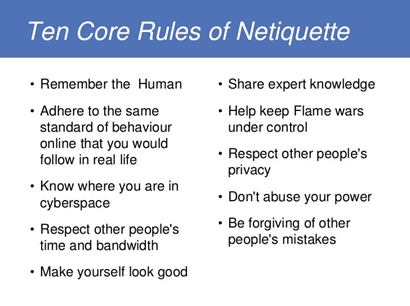
Source: Netiquette
To learn more about rules of netiquette, please read the following: Netiquette Guidelines - Columbus State University