Theory: Methodological Skills
2. Decision making
Introduction
To build or not a beach bar opens also to externa customers in our hotel? To offer or not light lunch in the pool bar or just refreshments and drinks? What to do to resolve the problem of cleaning the pool from leaves of the nearby plane tree? These are just three indicative situations that require to make a decision. In business, decision-making is a crucial part of any operation. Depending on the level at which the decision is made, there are three primary types of decisions: strategic, tactical, and operational. Each of these decisions differs in terms of their scope, time horizon, and impact on the organization.
Strategic decisions are high-level decisions that are made by top-level executives. These decisions are focused on the long-term goals and direction of the organization, e.g. to establish a new airline connection abroad, to introduce a new guided tour, to build a new aisle in the hotel with suites and an individual pool for each suite. Strategic decisions are typically made infrequently and have a significant impact on the organization. Examples of strategic decisions include mergers and acquisitions, diversification of products or services, and market entry or exit decisions.
Tactical decisions are made by middle managers and are focused on implementing the strategies set by top-level executives. Tactical decisions are made more frequently than strategic decisions and are generally focused on achieving short to medium-term goals. Examples of tactical decisions include hiring decisions, marketing campaigns, and product development decisions. In the tourism sector examples are hiring a new Japanese chef, following the strategic decision to find a sushi restaurant, to launch a social media campaign following the decision to offer a new guided tour, etc.
Operational decisions are made by front-line employees and are focused on day-to-day activities. These decisions are made more frequently than strategic and tactical decisions and are focused on achieving immediate goals. Examples of operational decisions include scheduling employees, ordering inventory, and resolving customer complaints. Examples of tactical decisions in the tourism sector are the contents of the tiny basket in toilets of a hotel, uniforms of staff in a restaurant, frequency of change of the menu etc.
In summary, strategic, tactical, and operational decisions are essential to the success of any organization. Each decision is made at a different level of the organization and has a different time horizon, scope, and impact on the organization. Understanding these different types of decisions is critical for effective decision-making and ultimately, organizational success.
Principles of Decision Making
To make a good decision, it is important to have clear and well-defined goals that align with your values and priorities. It is essential to consider all possible options or courses of action and weigh their pros and cons. Gathering relevant and accurate information and analysing it objectively are critical steps in making an informed decision. Every decision involves trade-offs and opportunity costs, and it is important to consider these factors in the decision-making process. Every decision involves some degree of risk and uncertainty, and it is important to assess and manage these factors appropriately.
Decision Making Techniques
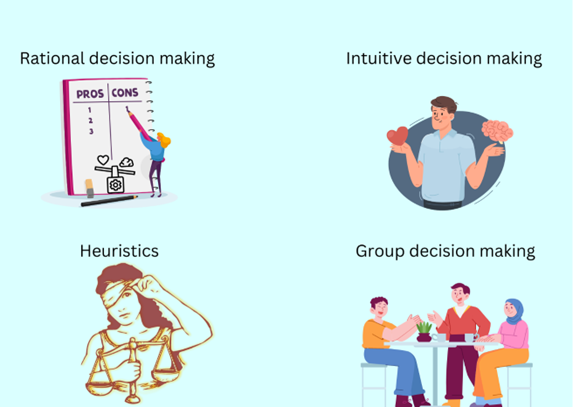
There are several techniques that can be used to make effective decisions. Rational decision making involves identifying the problem, collecting relevant information, generating alternatives, evaluating each alternative based on a set of criteria, and selecting the best one.
Some types of Decision-making are:
● Intuitive decision making involves relying on your instinct or gut feeling to make a decision, based on your past experiences and expertise. This type of decision relies upon the experience and talent of a specific person, more frequently of the manager, but have to take some time to be made, because even if the brilliant idea has come in a flash, it requires time to examine all parameters to make the decision work.
● Rational decision making is the opposite of intuitive decision making. It is a strict procedure utilising objective knowledge and logic. It involves identifying the problem to solve, gathering facts, identifying options and outcomes, analysing them, considering all the relationships and selecting the optimal decision. Even in this case, some phases of this procedure, as for example the identification of options, which is a creative activity and the ways to transmit enthusiasm to persons involved to make the decision a success, are not purely rational procedures.
● Heuristics are mental shortcuts that can help simplify complex decision-making tasks, but they can also lead to biases and errors if not used appropriately. The main problem of heuristics, which are based on how one acted in analogous cases in the past (e.g. difficult customers), is that it does not give the time or effort to conceive an entirely new and more creative solution, which could prove to be much more beneficial.
● Individual decision making is commonly accepted as an effective way of making up your mind on something, since you are focused and able to make prompt decisions. In a hotel the decisionmaker may be the manager. As the hotel manager is in many cases the owner and in others the person responsible in front of the owners, he/she often tends to make decisions by him/herself. It is however a problem when the manager demands that he/she has to be asked even for the slightest decisions e.g. if windows have to be opened, the music to be more aloud or not etc.
● Group decision making is about involving multiple stakeholders in the decision-making process, which can provide diverse perspectives and improve the quality of the decision. In many cases managers miss a lot of information that other members of staff in direct contact with customers may have.
Challenges of Decision Making
There are several challenges and pitfalls that can hinder effective decision making. People tend to be overconfident in their ability to make accurate predictions or judgments, which can actually lead to poor decisions.
- Confirmation bias is a tendency to seek out information that confirms existing beliefs and ignore information that contradicts them, which can lead to narrow-minded decisions.
- Escalation of commitment is a tendency to become more committed to a decision once time, money, or effort has been invested, which can lead to stubbornness and reluctance to change course.
- Group decision making can be affected by group thinking, which is a tendency to conform to the group's consensus and ignore dissenting opinions.
Decision making in tourism
Tourism is a delicate set of product, susceptible to a variety of factors including the decisions of powerful international tourism agencies that channel a great portion of tourism flows. Decision-making in tourism involves navigating through uncertain environments, considering stakeholder interests, and balancing short-term goals with long-term sustainability. Analytical thinking and problem-solving skills are necessary for identifying and defining problems, gathering relevant information, and generating solutions. Data-driven decision-making utilizes market trends and customer preferences to make evidence-based choices. Nowadays, many touristic companies including airlines, airports, car rentals, hotels etc., use quality management systems like ISO 9001 and collect, process analyze the opinions and remarks of customers as a standard procedure to gain insight of the quality of their services.
Risk assessment tools, such as SWOT analysis and scenario planning, help manage potential risks. Stakeholder engagement ensures diverse perspectives are considered for inclusive and sustainable outcomes. Ethical and sustainable decision-making prioritizes social, environmental, and cultural impacts. Adaptability and flexibility are essential for adjusting strategies in response to evolving trends and challenges.
Conclusion
Effective decision making is a complex and critical skill that can be developed and improved with practice and reflection. By applying the principles and techniques discussed in this chapter and being aware of the challenges and pitfalls, you can make informed and ethical decisions that align with your goals and values.