Theory: Social Media and Tourism
| Site: | DIGITOUR Training Platform |
| Course: | Building Digitalisation Readiness in the Tourism SME Sector - ENGLISH |
| Book: | Theory: Social Media and Tourism |
| Printed by: | Guest user |
| Date: | Thursday, 24 September 2026, 1:26 AM |
Table of contents
- 1. Introduction: Social Media and its importance in today's business world
- 2. Social Media for SMEs
- 2.1. Top 5 Tourism Bloggers Worldwide
- 2.2. Importance of your website as part of your Social Media strategy
- 2.3. SEO
- 2.4. How to access and understand analytics
- 2.5. Competitions and other opportunities
- 2.6. Paid social media – options
- 2.7. Main demographics for each social media platform
- 2.8. Social media advertising
- 3. Reading materials and links
1. Introduction: Social Media and its importance in today's business world
Social Media marketing is essential for every new start-up and
established SME to promote their products and services and
increase their brand awareness, enhance their digital marketing,
create awareness, brand recognition, and ultimately gain new
customers. The main benefits of adopting a social media campaign
for marketing purposes are cost effectiveness, brand recognition,
Increase level of customers satisfaction and increased brand
loyalty.
2. Social Media for SMEs
Overview of the main social media outlets
1. Facebook is the world’s largest and most popular social networking site. It allows users to create profiles, upload photos and videos, connect with friends and family, and share content.
2. Twitter is a microblogging platform that allows users to post short messages (up to 140 characters) known as “tweets”. It’s a great way to stay connected with friends and family, as well as follow news and events.
3. Instagram is a photo and video-sharing app that allows users to upload content to a public profile or keep it private. It’s a great way to stay connected through visuals, explore different cultures, and discover new interests.
4. LinkedIn is a professional networking platform that connects individuals and businesses. It’s a great way to build relationships and find new job opportunities.
5. YouTube is a video-sharing platform that allows users to upload, share, and watch videos. It’s a great way to showcase your talents, share experiences, and stay entertained.
6. TikTok is a social media application that allows users to create and share short-form videos. It also has a live streaming feature, where users can interact with each other in real time. The app has become incredibly popular and is being used by millions of people around the world. It has a wide variety of content, from funny skits to music videos to educational content. It also allows for users to find and follow other users, as well as like and comment on their posts. The platform is constantly evolving, with new features being added all the time.
Other Socials Media Platforms that maybe of Interest: Pinterest, Tumblr and Snapchat and Blogging.
2.1. Top 5 Tourism Bloggers Worldwide
1. Nomadic Matt – Nomadic Matt is a travel blogger, author, and entrepreneur. He has travelled to more than 75 countries and uses his blog to share budget travel tips and advice.
2. The Blonde Abroad – Kiki is a full-time traveller, influencer, and writer. Her blog is filled with travel tips, advice, and itinerary ideas for those looking to explore the world.
3. Adventurous Kate – Kate is a full-time travel blogger who has visited more than 85 countries and shares her experiences, tips and advice on her blog.
4. Breaking The Travel Barrier – Scott is a travel blogger and freelance writer who uses his blog to share stories, tips, advice, and travel photos.
5. The Planet D – Dave and Deb are a married couple who have been traveling the world together since 2006. They use their blog to share their experiences, photos and advice.
2.2. Importance of your website as part of your Social Media strategy
Your website is a crucial part of your social media strategy
because it is the hub of your online presence. Your website is
the place where you can direct people to find more information
about your brand and products, as well as make purchases. It is
also the main focal point where people can find all your social
media accounts and see what you are doing on each platform.
Additionally, your website can help you build trust with your
customers and show them that you are a legitimate business. With
the right website design, content, and SEO strategies, you can
increase the visibility of your website and attract more
customers.

2.3. SEO
Search engine optimization (SEO) is an ongoing process of
improving the visibility of a website or web page in search
engine results. It involves optimizing the content, technical
setup, and authority of a website to improve its organic search
engine rankings. SEO helps to ensure that a site is accessible to
a search engine and improves the chances that the site will be
found by the search engine.
2.4. How to access and understand analytics
- Establish Your Metrics: Before you start digging into social media analytics, it’s important to establish which metrics you want to track. This could include engagement, reach, impressions, website clicks and conversions.
- Set Up Trackers: Once you know what metrics you want to track, you need to set up trackers. This could be done through social media analytics tools such as Google Analytics, Hootsuite, Sprout Social or Buffer.
- Analyse Your Data: After the trackers are set up, you can begin to dive into your data. Look at how your posts and campaigns performed, identify any patterns or trends, and determine which posts were the most successful.
- Monitor Your Performance: Once you have analysed your data, it’s time to set up a monitoring system. This is important to ensure that you can track your progress over time and make adjustments if needed.
- Track Competitors: Finally, you should also consider tracking your competitors’ social media performance. This will give you an insight into how they’re performing and what strategies they’re using.
2.5. Competitions and other opportunities
Social media competitions and other opportunities available
include photo and video contests, sweepstakes, giveaways, trivia
challenges, Q&A sessions, influencer marketing campaigns, and
loyalty programs.
2.6. Paid social media – options
1. Paid ads on social media platforms are one of the most popular options for businesses looking to promote their products or services. Ads can be targeted to specific demographics and offer detailed reports on the performance of the ad. Popular platforms for paid ads include Facebook, Google Ads, Instagram, Snapchat, and Twitter.
2. Sponsored Content: Businesses can also use sponsored content to promote their products or services on social media platforms. Sponsored content involves paying influencers or content creators to create content related to the business’s products or services. This content can be shared on the business’s social media pages or on the influencer’s pages.
3. Social Media Management: Businesses can use social media management services to help manage their accounts and create content on a regular basis. This can include creating posts, responding to comments, and engaging.
Value of a blog
A blog can be a great way to express yourself, share your thoughts and opinions, and connect with others. It can also be a great platform for marketing, networking, and showcasing your work. It can be used to build a following and even generate income for your business. The value of a blog can be direct, but it can also open up collaboration with social media influencers that are aligned to your sector, business or geographical region.
Social Media Influencers
Social media influencers are people who have established credibility in a particular industry or niche. They can use their influence to promote products and services through their social media channels. Many influencers have huge followings on social media platforms, such as Instagram, YouTube, and Twitter. By leveraging their status, influencers can reach a large audience and have a significant impact on their followers’ purchasing decisions. As a result, brands are increasingly turning to influencers as part of their marketing strategies, with many offering financial compensation for promoting their products and services.
2.7. Main demographics for each social media platform
According to the Hootsuite:
“January 2022, the number of social media users worldwide was 4.62 billion. That’s more than half of the entire population of earth.
Globally, we spend an average of 2 hours and 27 minutes on social media per day.” The average user spends about 35% of their total time using the internet on social media.
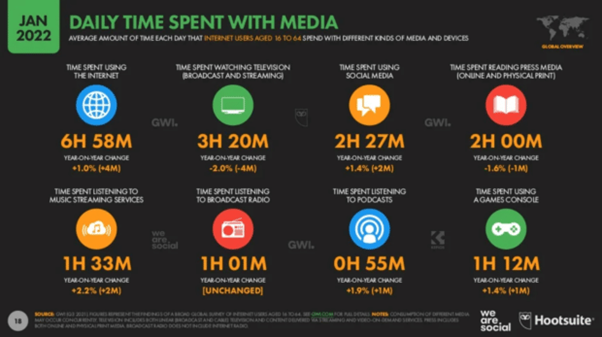
“Facebook is still the world’s most popular social media platform. It currently has almost 3 billion global active users.”
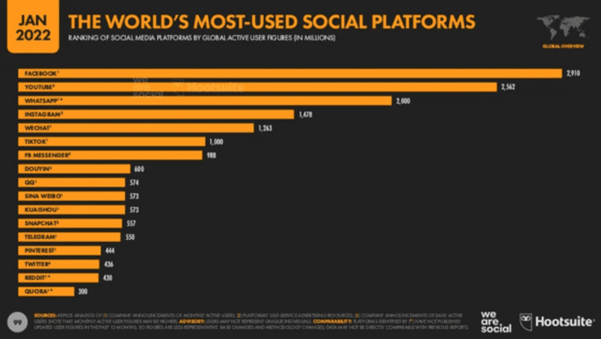
https://blog.hootsuite.com/social-media-demographics/
Demographic of a European Facebook User Verses Instagram User
Age: Facebook is most popular among younger people in Europe, with 76% of 18–24-year-olds and 71% of 25–34-year-olds using the platform, according to a 2021 study by Eurostat. The percentage of users decreases with age, with 41% of 55–74-year-olds and 18% of those aged 75 or over using the platform.
Gender: There is a roughly equal split between male and female Facebook users in Europe, although this varies somewhat by country.
Income: Facebook usage is also more common among people with lower incomes in Europe. According to a 2021 survey by the Pew Research Center, 60% of people with household incomes under €30,000 per year use Facebook, compared to 47% of those with incomes of €30,000-€60,000 and 36% of those with incomes over this amount.
Age: The largest age group on Instagram in Europe is between 18-24 years old, followed by the 25-34 age group. This suggests that Instagram is particularly popular among younger people in Europe.
Gender: Instagram users in Europe are slightly more likely to be women than men, although the difference is not significant.
Location: The largest number of Instagram users in Europe are located in Germany, France, and Italy, although there are significant numbers of users in other European countries as well.
Income: Instagram users in Europe come from a wide range of income levels. While there are many users with relatively low incomes, there are also many who are relatively affluent.
Interests: Instagram users in Europe tend to be interested in fashion, beauty, travel, food, and lifestyle content. However, this varies widely depending on the specific user and their preferences.
Overall, Instagram is a popular platform among younger people in Europe, particularly women, and is used for sharing and consuming visual content related to a variety of interests and aspirational. Facebook is seen as accessible to a wider audience.
2.8. Social media advertising
Top tips:
· You do not need to spend hundreds of euros.
· There will be a lot of trial and error - what works well for one business may not work for another.
· Always let your post perform organically for 24 hours before you look into boosting it.
· Don't let the ad run for too long - 4/5 days max.
Pros:
— You can target your reach: Paid social media advertising allows businesses to target specific audiences based on demographics, interests, behaviours, and location, increasing the chances of reaching their target audience.
— Increased visibility: Social media ads increase the visibility of a brand, as they appear in the news feeds of potential customers, increasing the chances of brand recall.
— Cost-effective: Social media advertising is often less expensive than traditional forms of advertising and can be tailored to fit any budget.
— Measurable results: Social media advertising allows businesses to track their results, such as reach, engagement, and conversions, providing valuable data for optimizing future campaigns.
— Flexibility: Social media advertising can be flexible, allowing businesses to adjust campaigns on the fly based on performance.
Cons:
— Remember that users may get tired of seeing the same ads repeatedly, resulting in ad fatigue, which can reduce the effectiveness of social media ads over time.
— High competition: With so many businesses using social media advertising, competition for ad space can be high, making it harder to stand out.
— Limited organic reach: Social media algorithms prioritize paid content, making it harder for organic content to get visibility and engagement.
— Ad-blocking: Some users may use ad-blocking software, which can prevent social media ads from reaching them.
— Ad blindness: Users may be accustomed to ignoring ads, resulting in low engagement rates and limited conversions.
Social Media Advertising Options
There are several social media advertising options available, including:
- Facebook Ads: Facebook is one of the most popular social media platforms, with over 2 billion active users. Facebook Ads allow businesses to target specific demographics, interests, behaviours, and locations, as well as retarget users who have previously interacted with their content.
- Instagram Ads: Instagram is a highly visual platform that allows businesses to create ads that blend in seamlessly with organic content. Instagram Ads can be targeted based on demographics, interests, behaviours, and locations, as well as retarget users who have engaged with their content.
- Twitter Ads: Twitter Ads allow businesses to promote their accounts, tweets, or trends to targeted users based on interests, behaviours, and keywords. Twitter Ads can be used to increase brand awareness, drive website traffic, and boost engagement.
- LinkedIn Ads: LinkedIn is a professional networking platform that allows businesses to target users based on their job title, company size, industry, and seniority. LinkedIn Ads can be used to promote job listings, build brand awareness, and generate leads.
- YouTube Ads: YouTube is a video-sharing platform that allows businesses to create video ads that appear before, during, or after videos. YouTube Ads can be targeted based on demographics, interests, and topics.
To advertise on Facebook and Instagram as both are managed from Facebook and you can follow these steps:
— Set up a Facebook Ads account: Go to the Facebook Ads Manager page and create a new account or log in with your existing account.
— Choose your objective: Facebook offers a variety of advertising objectives, such as brand awareness, traffic, conversions, and more. Choose the objective that best aligns with your marketing goals.
— Define your target audience: You can choose specific demographics, interests, behaviours, and more to target your ideal audience.
— Set your budget and schedule: Decide how much you want to spend and for how long you want your ad to run.
— Create your ad: Choose the ad format (image, video, carousel, etc.), add your text and visuals, and preview your ad before submitting.
— Launch your ad: Once your ad is approved, it will start running according to your budget and schedule.
— Monitor and adjust: Check your ad performance regularly and make any necessary adjustments to optimize your results.
3. Reading materials and links
https://www.youtube.com/watch?v=StYGaCeaRkQ
https://www.youtube.com/watch?v=3fJqcPF_dgU
Create a Facebook Page for your business | Meta Business Help Centre
https://business.instagram.com/
https://sproutsocial.com/insights/how-to-create-youtube-account/
https://business.linkedin.com/marketing-solutions/linkedin-pages