Theory: Collaborating With Others - Networking & Co-creation
| Site: | DIGITOUR Training Platform |
| Course: | Building Digitalisation Readiness in the Tourism SME Sector - ENGLISH |
| Book: | Theory: Collaborating With Others - Networking & Co-creation |
| Printed by: | Guest user |
| Date: | Thursday, 24 September 2026, 1:26 AM |
1. Introduction
This Module aims to explore the opportunities and benefits of collaboration and co-creation with other relevant actors and stakeholders for tourism businesses in Europe, as a mechanism to enable and facilitate innovation, as well as to ensure the resilience of the business and the attractiveness of the area in which it operates.
In accordance with the training framework of the DIGITOUR programme, the theoretical content of the Module focuses especially on the development of digital skills and competences of tourism entrepreneurs and professionals, but keep in mind that they are equally useful in their face-to-face applicability.
Initiating a process of exchanging interests and objectives for collaboration is the first step of a co-creation project (which implies per se a collaboration between two or more parties), and for this it is necessary to know the right actors. Therefore, the relevance of (digital) networking for any company/professional will also be discussed in the following.
Also noted that, according to the ever-changing nature of digital solutions and IT advances, some information contained in the Module can potentially be outdated in years to come.
2. Collaboration Process

Source: Las Manos Dedo Toque - Imagen gratis en
Pixabay
A collaboration process can take place between different actors (from the same or different areas of activity), take different forms and pursue a wide variety of objectives, depending on the interests of the parties involved. What is essential in any case is to understand that collaboration is about cooperating with others in an honest way.
Collaboration between companies, professionals, initiatives and/or different stakeholders (customers, suppliers, policy makers, public bodies, civic society organisations, etc.) favours the competitiveness and continuous growth of tourism companies, as it is a driving force for innovation in a sector in constant change and evolution of trends. Thus, being able to collaborate and quickly respond to the needs of the market and its changing context may be key for most SMEs/(prospective) professionals.
2.1. Your Ecosystem
The first step to initiate a collaboration (or a professional contact with a relevant actor in your sector/community) is to understand the relevance of your ecosystem as a company or (future) professional in the tourism sector.
The term "ecosystem" can have two meanings here:
a) Firstly, it can be defined as a biological system constituted by a community of living organisms and the physical environment where they are related. The natural environment and/or the biological diversity of your area can be an element of great relevance for the tourist attractiveness of the region and, therefore, a factor to consider in the development of your professional activity.
b) As far as the DIGITOUR training programme is concerned, the "ecosystem" itself is understood as the set of actors and professionals that act or have influence in your area of activity (geographically or sectorially speaking) and that, therefore, co-construct the conditions in which you develop your activity or provide your services to potential clients. From a globalised perspective, the ecosystem in which you develop your activity is increasingly broad. An example of this is the increasingly important role played by the digital presence of companies, which allows them to access new markets at the click of a button or to establish international professional contacts quickly.
Knowing your ecosystem will allow you to more easily identify people to network with, but keep in mind that there are also people outside your direct ecosystem who could be very relevant.Therefore, we recommend that you spend some time reflecting on your "ecosystem" at different levels:
● Who are the most relevant actors for your activity in terms of influence / power?
● With which professional/business profiles would you be interested in collaborating in the future? Why?
● Where are these actors located? Geographically, sectorially, within the logistics chain, etc.
● Do you both share common values?
● What resources do you need? Is there any business or organisation owning them?
Once you have mapped your ecosystem, it will be easier to identify those people or organisations you are interested in. If you already know them, you can start the collaboration process, but if you don't know them, a first step on the road to collaboration is networking (see more about digital networking opportunities in the next section of the Module).
However, sometimes one’s ecosystem is easier to grasp as initially it seems. On that note, you can think of your professional inner ecosystem as both: employees (or colleagues) and customers!
2.2. Collaborate
Developing collaborative skills, as any other Methodological Skill (you can learn on DIGITOUR Methodological Skills Module), requires a combination of training, practice, and feedback.
● Training can provide professionals in tourism with the knowledge and tools to collaborate effectively.
● Practice can help you (and your employees) to apply collaborative skills in real-life situations.
● Feedback can enhance collaborative skills by identifying strengths and weaknesses.
As such, SMEs can develop collaborative skills by creating a collaborative culture, providing opportunities for teamwork, and rewarding collaborative behaviour. Even if you aim to be a solo-entrepreneur, working on your collaborative skills will pay off in terms of networking and learning from others.
To better understand the power of collaboration and sharing with others and the positive effects this can have on your performance, we invite you to take a look at the following video:As mentioned above, there are many different types of collaboration. This largely depends on the expectations and needs of the parties.
For example, if you are the manager of a tourist accommodation you could collaborate on a small scale with a local guide and offer a discount on their services to your customers at check-in to enhance their tourist experience in the locality. Or, for example, you could be part of a sector cluster that collaborates with public authorities to develop business guidelines to ensure the resilience & sustainability of tourism in the area. In this way, you would put your expertise and professional experience at the service of the entire business fabric of the local/regional/national ecosystem.
You must understand that collaboration is not just about direct benefit through working together, but is about engaging with others to deliver joint value. This means that the ideal is to generate win-win situations in which all parties benefit.
Two of the most common collaboration processes usually take place between you and your employees/colleagues or customers.

Collaboration Between Employees
Collaboration between employees of a SMEs involves working together as a team to achieve common goals. Collaboration between employees or colleagues can improve efficiency, productivity, and innovation.
Collaborative skills are necessary for effective teamwork, where each member brings their unique skills and experiences to contribute to the success of the team. It requires effective communication, trust, and mutual respect.
If you are a (prospective) solo-entrepreneur, if possible, you can think of “colleagues” as other entrepreneurs/stakeholders working towards the same goals in your area of activity. Let’s imagine, for instance, collaborating with a cluster of small businesses aiming to promote a tourist destination.
- On that note, you can learn more about the vital importance of applying social skills in collaboration with colleagues in the workplace (teamwork), you can read more at: Examples of Communication and Collaboration Skills | Indeed.com Australia
Collaboration with Customers
Collaboration with customers involves working together to meet customer needs, aiming to improve customer satisfaction, loyalty, and retention.
It requires effective communication, active listening, and empathy, which are necessary to build strong relationships with customers, gain insights and create value for them.
We will now look at some of the steps to follow to start a collaboration process with other relevant actors in your network or tourism ecosystem.
2.3. Collaboration Process
Regardless of the form the collaboration takes, the following stages can generally be observed:
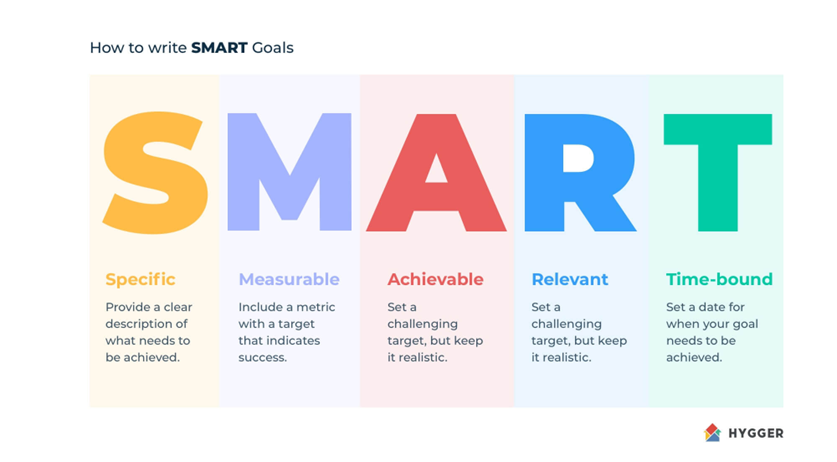
- Identification of SMART goals and objectives. This answers the question: why collaborate with others, what benefits do you seek to gain from the collaboration process?
 Source: How to Formulate and Apply SMART Goals and Objectives? |
Hygger.io
Source: How to Formulate and Apply SMART Goals and Objectives? |
Hygger.ioWe suggest that, as you begin to reflect on a future collaboration, you set 3 SMART objectives in advance that align with your business mission and vision.
- Mapping potential collaborators. Networking, as we shall see, is a key tool for any professional and is also particularly important when initiating a collaboration process with others, as it allows access to a variety of profiles that meet the needs and expectations of the collaboration.
- Define roles and responsibilities for the collaboration. Assigning clear roles and tasks among the participants will be key for the follow-up and management of the collaboration process, as well as for monitoring the results and establishing corrective measures if necessary. For an optimal outcome, it is necessary to make an effort to understand each other's needs and objectives, and to reach an agreement that is realistic and beneficial for all involved.
- Co-design a communication and collaboration management protocol. In the case of a long-term collaboration, or if the complexity of the project requires it, it will be necessary to design a protocol that all collaborators will follow when working together. In addition, establishing guidelines on how to communicate will help to reduce potential risks.
- Evaluation of results. Whether it is a one-off collaboration or a sustained professional relationship that generates added value for all partners, it will be necessary to monitor the results obtained through the collaboration. In this way, it is possible to detect areas for improvement or to understand whether the time and effort invested have been efficient.
All these stages of collaboration can take place both in the face-to-face and online environment, especially if we take into account that as a consequence of globalisation and the internet, it is more and more likely to establish collaborative processes with agents who are located at a distance.
For the online management of a collaborative process with others, you will need to use digital tools such as:
● Digital communication tools: email, social networks, video call solutions, etc.
● Task/project management tools (when required by the results to be achieved): there are many online task managers that can be easily incorporated into your daily activities, such as ClickUp, Trello, Asana, etc.
2.4. Overcoming barriers to Collaboration online
There are several common barriers to collaboration among Small and Medium-sized Enterprises (SMEs) and professionals in the tourism sector in Europe. These barriers might be intensified when trying to reach out online, but they also represent a great opportunity for self-learning and innovation.
The following are some of the barriers you may face when trying to collaborate with other actors in the sector, as well as strategies to overcome them effectively:
- Lack of awareness: Many SMEs and professionals in the tourism sector may not be aware of the benefits of collaboration or may not understand how collaboration can positively impact their businesses.
Strategy - Initiatives such as workshops, seminars, and training programs can be organised to raise awareness about the benefits of collaboration and how it can positively impact SMEs in the tourism sector.
To participate in any of these events, you can keep up to date with opportunities that interest you through specialised forums or relevant posts on social networks such as LinkedIn.
If you feel that none of these options suit your current needs, you can also organise your own online chat to get you started. Select a diverse profile of professionals who can actively contribute their expertise and curiosity and organise a meeting with them to share insights. You can use common tools such as Google Meet, Zoom, Teams, Skype,...
- Limited resources: SMEs in the tourism sector may have limited financial and human resources, making it challenging to invest in collaborative efforts or allocate time and personnel for collaboration. Another of the most scarce resources when it comes to researching, evaluating and implementing partnership opportunities is time. This is especially limiting if you are a solo-entrepreneur.
Strategy: we recommend applying a strategic mindset and only value those collaborations that add value to your tourism offer or help you develop your professional skills.
Also encouraging a collaborative culture among your ecosystem sheds light on the benefits of sharing resources, knowledge, etc. to strengthen the business fabric and attractiveness of the region for future customers.
- Competitiveness: Some SMEs in the tourism sector may view other businesses as competitors and may be reluctant to collaborate due to concerns about sharing their knowledge or resources with potential competitors.
Strategy: Instead of thinking of other players and professionals in your ecosystem as competitors, it would be interesting to think of them as part of a team of professionals with a common interest. What characteristics of your businesses or offerings make you complementary? How can you help each other to provide value to your customers and align with new tourism trends (i.e., sustainable tourism)?
Try to communicate these ideas through your professional digital presence and in formal/informal networking conversations.
- Communication challenges: Language barriers, cultural differences, and geographical distances can pose challenges to effective communication and coordination among SMEs and professionals in the tourism sector in Europe
Strategy: Efforts can be made to overcome communication challenges by providing language support, promoting cultural understanding, and utilising technology platforms that facilitate communication and coordination among collaborators.
Moreover, taking into account the effects of globalisation and the facilities that technology offers to collaborate with professional profiles from other parts of the country (or at European level!), it would be advisable to at least use English as a common language and be aware of the possible cultural differences you will have to deal with in order to avoid misunderstandings.
- Trust and relationship building: Building trust and developing relationships among SMEs and professionals in the tourism sector may take time and effort, and lack of trust among potential collaborators can hinder collaboration.
Strategy: Building trust among potential collaborators through networking, shared experiences, and mutual benefits can foster collaboration in the tourism sector. Building long-term relationships based on trust can help overcome initial reluctance to collaborate.
In this sense, social media presence and relationship management with stakeholders and customers can be facilitated by the use of communication and monitoring tools such as online satisfaction surveys, corporate emails, stakeholder friendly emails, online meetings between professionals in the sector, professional posts and interactions on Facebook, LinkedIn, participation in online events, etc.
Consistency and honesty in your communication will be key to building long-term relationships based on mutual respect and trust.
Overcoming barriers to collaboration among SMEs and professionals in the tourism sector in Europe requires a multi-faceted approach, including raising awareness, providing resources, facilitating communication, simplifying regulations, and fostering trust and relationship building.
By addressing these barriers, SMEs and professionals in the tourism sector can harness the benefits of collaboration, such as increased innovation, improved competitiveness, and enhanced sustainability, to achieve mutual success.
How can you contribute to lowering these barriers? What digital skills or competencies would be useful for you to achieve this?
3. Digital Networking
 Source: https://pixabay.com/es/vectors/medios-de-comunicaci%c3%b3n-social-3846597/
Defined as an "exchange of information, knowledge and ideas between people who share a common profession or special interest” (Investopedia, 2022), networking is an essential activity for any professional, as it allows you to expand your network, and potentially allows you to access new ideas and resources.
To have a better first approximation to what networking means for a business, have a look at the following video and get yourself inspired by the stories and experiences of others:
As you might probably already know, networking is nowadays key for small business owners because it allows them to reach their goals faster, increases their visibility, provides future professional options and offers access to people/resources that otherwise will be unavailable.
In addition to being an excellent tool to expand and strengthen your professional relationships and, consequently, provide support to your (idea of) social entrepreneurship in sport and/or inclusive leisure, some of the main benefits of networking to take into account are, among others, these listed below.
DIGITAL NETWORKING
In terms of online networking, one can highlight the use of social networks to connect with other professionals or entrepreneurs in order to establish solid relationships for the future.
When you are first developing your social enterprise concept and gathering initial feedback, you may find that online networking is less intimidating. Furthermore, digital networking can be a valuable asset for rural social businesses, which frequently face geographical, time, and financial constraints that limit their ability to network in person or attend events.
In addition to attending digital events, social networks play a key role in the development of networking. This is especially true for those social networks specifically designed for professionals, such as LinkedIn, which allows you to connect with professionals interesting for your business.
Other platforms that can be attractive are:
- 100AM
- Meetup (e.g., Travel Bloggers & Startups Spain (Valencia, España) | Meetup)
- Facebook Groups - e.g., Responsible Tourism Networking | Facebook
In the specific case of the tourism sector, which has an important weight in the GDP of many European countries, it is common for there to be networking networks or clusters of companies and professionals at local or regional level that come together to defend common interests and enhance the tourist attractiveness of their areas of influence. This type of collaboration can be very enriching for accessing peer-learning opportunities, sources of innovation and offering better customer service.
You can also join different groups in these social media and start interacting. An active group member is bound to receive more invitations to connect from others. In any case, the key to establishing professional relationships in the digital environment is to build a good online presence, remain visible and actively interact with others through: commenting on publications or blog posts, participating in interviews or webinars, publishing one's progress.
3.1. Overview
In terms of online networking, one can highlight
the use of social networks to connect with other professionals or
entrepreneurs in order to establish solid relationships for the
future.
When you are first developing your social enterprise concept and gathering initial feedback, you may find that online networking is less intimidating. Furthermore, digital networking can be a valuable asset for rural social businesses, which frequently face geographical, time, and financial constraints that limit their ability to network in person or attend events.
In addition to attending digital events, social networks play a key role in the development of networking. This is especially true for those social networks specifically designed for professionals, such as LinkedIn, which allows you to connect with professionals interesting for your business.
Other platforms that can be attractive are:
- 100AM
- Meetup (e.g., Travel Bloggers & Startups Spain (Valencia, España) | Meetup)
- Facebook Groups - e.g., Responsible Tourism Networking | Facebook
In the specific case of the tourism sector, which has an important weight in the GDP of many European countries, it is common for there to be networking networks or clusters of companies and professionals at local or regional level that come together to defend common interests and enhance the tourist attractiveness of their areas of influence. This type of collaboration can be very enriching for accessing peer-learning opportunities, sources of innovation and offering better customer service.
You can also join different groups in these social media and start interacting. An active group member is bound to receive more invitations to connect from others. In any case, the key to establishing professional relationships in the digital environment is to build a good online presence, remain visible and actively interact with others through: commenting on publications or blog posts, participating in interviews or webinars, publishing one's progress.
3.2. Benefits of Networking
● Networking is the method that allows you to build long-lasting business relationships. Digital networking, especially, provides you with a great opportunity to get in touch with prospective partners in a quick and easy way. Your next collaboration might have started with just 1 click!
● Is there any current challenge to overcome in the tourism sector in your region? Networking can be seen as an opportunity to come together to face common challenges and cooperate in their resolution. Thus, a varied and solid network of contacts will favour the opportunity to collaborate with other actors in the co-ideation, co-creation, co-design and/or launching of innovations to the market. Thanks to networking, it’s possible to meet organisations/people who share their mission and values and/or face the same issues, and therefore find opportunities for collaboration to work together on common projects. In this way, they can also amplify their positive social impacts.
● Similarly, networking allows for mutual learning, especially when dealing with professionals/enterprises from the same or another sector that have already faced and overcome the challenges of tourism (and digitalisation). In addition, the exchange of experiences and opinions is an excellent vehicle for knowledge among actors that fosters innovation.
● Access to resources will also be facilitated by the networking activity. This is because, in addition to facilitating collaborative processes that bring the resources and skills of the different participants to the table, sharing what you want to achieve will make it easier for someone in your network to help you, or to know a third party who can give you recommendations or put you in touch with someone who shares your vision and can be useful.
● Access to additional resources is especially important for social enterprises that, in many cases, do not have solid financial backing in their early stages, so by building relationships and contacts in the business community, social enterprises can have access to a wide range of resources that can be useful for the growth and development of the organisation, such as funding, mentoring, professional services, and volunteerism.
● On the other hand, networking also offers advantages when it comes to promoting and communicating your idea/product/service. By sharing your offer, vision and values with other professionals and stakeholders, it will be easier to expand your message and possibly access additional dissemination channels facilitated by your contacts. These relationships will be essential to the success of your firm, especially if you operate as a solo entrepreneur.
● Create a sense of community for yourself with others, as well as for others with yourself.
3.3. Key factors of Networking
How to Network Online Effectively: A Beginner’s Guide
For many, networking can be a natural and easy activity to engage in, while for some it is more complicated to establish contact and build mutually beneficial relationships with others over the long term. But don't worry! Networking, like creativity or public speaking skills, can be improved through practice.
Some competencies and skills considered key to successful networking are as follows:
- Communication skills: Effective communication is essential for building relationships and partnerships with other organisations and individuals. Social entrepreneurs should be able to articulate their mission, values, and goals clearly, and listen actively to the perspectives of others.
To reflect on the importance of a strategic communication online and offline, have a look at the video:
Some skills for effective communication with others are:
● Active Listening
● Empathy & Emotional Intelligence
● Verbal Communication
● Non-verbal Communication
● Public Speaking
● Negotiation
● Netiquette
To learn more about social skills in a digital environment, you can have a look (again) to Module 3.
- Relationship-building skills: Networking is all about building relationships with others, and social entrepreneurs need to be able to establish and maintain strong relationships. This requires, again, skills such as empathy, active listening, and the ability to connect with people on a personal level.
- Strategic thinking: Successful networking requires a strategic approach, and social entrepreneurs should be able to identify potential partners and opportunities for collaboration. They should also be able to assess the risks and benefits of different partnerships and make informed decisions.
- Entrepreneurial mindset: which includes creativity, innovation, and a willingness to take calculated risks. Tourism professionals should also be able to identify and seize opportunities, and be persistent in pursuing their goals.
- Flexibility and adaptability: Networking can be unpredictable, and as such you need to be able to adapt to changing circumstances and opportunities. This requires flexibility and a willingness to explore new ideas and approaches.
- Cultural competence: Networking often involves connecting with people from diverse backgrounds and cultures. Social entrepreneurs should be able to navigate cultural differences and communicate effectively with people from different backgrounds.
- Curiosity - Be open to new ideas: Humans are designed for lifelong learning. Being open to new ideas which may be different from what you thought you are going to find while networking means that you are most likely to learn new ways to do what you want to do. This could be attracting new customers, or perhaps partnering and developing a new initiative? Just because things do not look like how you have imagined them, it does not mean they are not worth being considered.
4. Co-creation
 Source: CANVA
Co-creation is a collaborative process that, per se, provides companies and professionals with the benefits of collaborating with others in the generation of win-win situations and positive impacts on their ecosystem.
Therefore, co-creation, like other types of collaboration, acts as a driver of creativity and business innovation, key tools in a sector that, as we have pointed out above, is constantly adapting and renewing itself.
Co-creation is a collaborative process between two or more enterprises or entities with the goal of innovating and developing new concepts, ideas, products, services, or experiences through the shared processes of ideation, envisioning, and designing that address the demands of the potential customers. We might say that the relationship creates strength in this way. This is accomplished through encouraging entrepreneurial creativity through the interchange of ideas, experiences, information, and expectations.
4.1. Co-design & Co-creation
There are a multitude of types and levels (take a look at the next section to learn more about this) in which co-creation can take place within the tourism ecosystem of a community/region.
However, in general, when thinking about co-creation in a business context one tends to think of processes in which corporations include their (potential) customers in the process of co-ideation and co-design of products/services or innovations that can effectively and satisfactorily respond to the expectations and needs of the target group. In that sense, co-creation can be a particular example to the collaboration with customers previously mentioned.
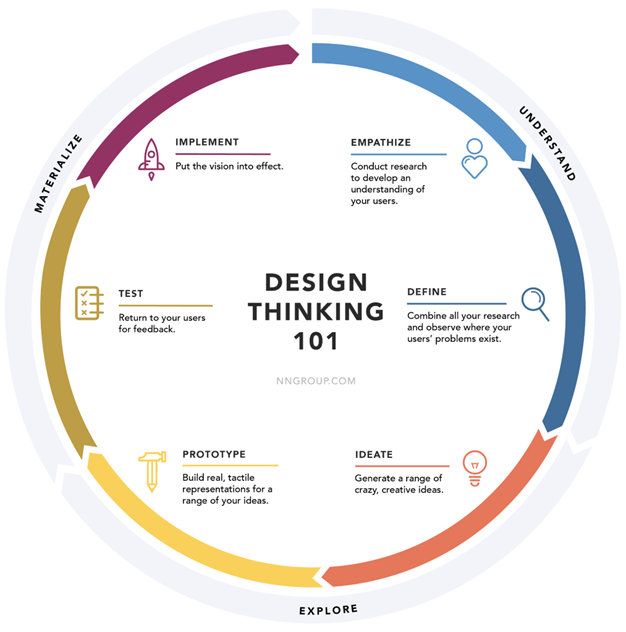
Precisely linked to this idea is the conception that co-creation is closely linked to co-design (note that they are often intertwined processes, but can also occur separately), and, in turn, this collaboration goes through the phases of what is known as Design Thinking of design or innovation.
● Co-creation: partnership between companies, organisations, and/or users/customers that involves sharing discussions and experiences in order to establish collaborative initiatives and co-create goods and/or experiences that are appropriate for the context.
● Co-design: Co-design, also known as "participatory design," is the process of creating a product or service in collaboration with stakeholders (e.g. employees, partners, customers, citizens, end users). It describes the procedure by which a user or group of users, along with other important stakeholders, actively participates in the design of a specific good or service, offering suggestions and direct responses to guarantee the final products are useful and environmentally friendly while also meeting the needs of end users.
The co-design process is most closely related to the Design Thinking ideation process, or the process of coming up with new goods and/or service concepts. For its part, the co-creation process is more closely related to the convergent thinking of Design Thinking. This means, with the implementation of innovation, testing, etc.
Source: Design Thinking: Study Guide
You can learn more about the Design Thinking methodology through the following post: Design Thinking - A Creative Strategy For Innovation
4.2. Levels of Co-creation
Co-creation, a concept popularised in the field of innovation and marketing, involves collaborative efforts among different stakeholders to jointly create or develop value-added products, services, or experiences. There are typically three levels of co-creation:
- Basic level co-creation: At this level, co-creation involves gathering feedback and insights from customers or end-users to inform the design or development process. It may involve conducting surveys, focus groups, or interviews to gather customer preferences, needs, and ideas. This level of co-creation is typically focused on obtaining customer input to enhance existing products or services, rather than involving customers in the actual creation process.
- Intermediate level co-creation: This level of co-creation involves a higher degree of collaboration between the organisation and its customers or end-users.
It may involve joint brainstorming sessions, workshops, or collaborative platforms where customers and stakeholders actively participate in generating ideas, designing solutions, and prototyping. The goal is to involve customers and/or other relevant stakeholders in your ecosystem more directly in the innovation process and leverage their knowledge, creativity, and expertise to co-create new products, services, or experiences.
- Advanced level co-creation: At this level, co-creation involves deep collaboration and integration of customers/stakeholders or end-users into the entire value chain of the product or service development process. Customers or end-users become active partners and co-creators, contributing to various stages of the innovation process, including idea generation, design, development, testing, and implementation. Advanced level co-creation may involve forming co-creation communities, living labs, or innovation ecosystems where multiple stakeholders collaborate closely to co-create solutions that meet the needs of all participants.
It's important to note that the levels of co-creation can vary depending on the context, industry, and specific goals of the co-creation initiative.
Organisations can choose the level of co-creation that best aligns with their objectives, resources, and customer engagement strategies.
4.3. Benefits of Co-creation with Others
Co-creation can offer several benefits to Small and Medium-sized Enterprises (SMEs) and professionals in the tourism sector in Europe. Some of the main benefits of co-creation for SMEs and professionals in the tourism sector are pretty similar to the ones stated in the Networking section, and therefore include:
● Enhanced innovation: Co-creation can foster innovation by involving customers or end-users in the process of generating ideas, designing solutions, and prototyping. This can lead to the development of new and innovative products, services, or experiences that better meet customer needs and preferences, and thus provide a competitive advantage for SMEs and professionals in the tourism sector.
● Increased market relevance: Co-creation allows SMEs and professionals in the tourism sector to better understand customer needs, preferences, and trends. By co-creating solutions with customers and other experts in the field, SMEs can ensure that their products or services are more relevant and aligned with customer demands, leading to increased market relevance and competitiveness.
● Improved customer engagement and loyalty: Co-creation involves active participation and engagement of customers or end-users, which can create a sense of ownership and loyalty. By involving customers in the co-creation process, SMEs and professionals in the tourism sector can build stronger relationships with their customers, enhance customer satisfaction, and improve customer retention.
●
Shared risks and resources: Co-creation enables
SMEs and professionals in the tourism sector to share risks and
resources with customers or other stakeholders. By collaborating
with customers, SMEs can leverage the knowledge, creativity, and
expertise of external partners, leading to more effective and
efficient product or service development processes.
CO-CREATION in a DIGITAL environment
Co-creation can also be developed in a digital environment, leveraging technology to facilitate collaboration and engagement.
Some simple strategies to develop a co-creation process in a digital environment for SMEs and professionals in the tourism sector in Europe include:
- Online collaborative platforms: Utilising online platforms, such as collaborative websites, virtual brainstorming tools, and social media groups, can facilitate remote collaboration among stakeholders in the tourism sector, enabling them to share ideas, feedback, and resources.
- Virtual workshops and webinars: Conducting virtual workshops, webinars, or online focus groups can enable SMEs and professionals in the tourism sector to engage with customers and stakeholders in a digital environment, facilitating co-creation activities and idea generation.
- Crowdsourcing and open innovation: Implementing crowdsourcing or open innovation platforms can allow SMEs and professionals in the tourism sector to source ideas, feedback, and solutions from a larger audience, including customers, suppliers, and other stakeholders, through digital channels.
- Social media engagement: Social media platforms can be utilised to foster engagement and co-creation with customers and stakeholders in the tourism sector. Social media can enable SMEs to gather feedback, ideas, and suggestions from customers, and involve them in the co-creation process. Have a look at Module X to learn more about social media presence and online marketing strategies for your business (idea).
- Virtual reality (VR) and augmented reality (AR): Utilising VR or AR technologies can enable SMEs and professionals in the tourism sector to create virtual experiences or prototypes for co-creation, allowing customers and stakeholders to provide feedback and suggestions in a virtual environment.
This is a more advanced technology that may seem complicated for small companies, but by collaborating with the right partners, very successful results can be achieved. For example: Tourism and Culture | AR Vision
Overall, leveraging digital technologies can facilitate co-creation processes among SMEs and professionals in the tourism sector in Europe, enabling remote collaboration, increased engagement, and efficient idea generation and prototyping.
4.4. Good Practices
When beginning a collaborative process from scratch, engagement and motivation are crucial components. Moreover, networks may be crucial in luring partners to the collaborative process. Developing strong and reliable professional relationships will take time, but bear in mind they should be based on shared values and compatible goals.
Again, as it happens for any collaboration process or, honestly, any other interaction-based process, the participation of all partners should be ruled by some principles:
● For the collaboration to proceed properly, there needs to be mutual trust and respect amongst the involved entities.
● Create an end-user-driven, transparent value generating process.
● The process should be built on the growth of creativity and the sharing of resources and information amongst entities since the main goal is an innovation that adds value for customers.
● It will be helpful to create own action guides that include methods for resolving potential disagreements in the case of collaborative action in the medium or long term. Moreover, boundaries and scopes should be made clear in advance.
● Set deadlines and SMART objectives.
● Creativity is fueled by connectivity.
Have a look at the following video to get inspire on a great real example of collaboration and co-creation:
5. Reading / Additional materials
● How do you collaborate effectively with subject matter experts and reviewers?
● Top tips for a beautiful e-learning relationship: how to successfully collaborate with SMEs
● How do you collaborate effectively with subject matter experts and reviewers?
● “Collaboration and Co-Creation: The Road to Creating Value” – Gaurav Bhalla