Theory: Digitalisation and Tourism
| Site: | DIGITOUR Training Platform |
| Course: | Building Digitalisation Readiness in the Tourism SME Sector - ENGLISH |
| Book: | Theory: Digitalisation and Tourism |
| Printed by: | Guest user |
| Date: | Friday, 25 September 2026, 4:18 AM |
1. Introduction
“The tourism sector is more and more visible on the web. Many companies now only operate on the Internet, resigning from stationery offices. This is a branch of online tourism.
UNWTO – the World Tourism Organization has declared its willingness to organize online trainings, including promoting implemented technologies that support the need to maintain social distance in tourist facilities [1]”.
The digitization of the tourism industry is bringing about significant changes and is creating new opportunities for professionals in the field. This module aims to equip learners with the knowledge and skills necessary to succeed in this dynamic landscape.
Throughout the module, learners will gain an understanding of the fundamental concepts of digitization in tourism, including emerging technologies and their impact on the industry. They will also explore the challenges and opportunities associated with digitization and learn how to evaluate and identify potential solutions to these challenges.
Learners will develop practical skills in using digital tools and technologies to enhance the tourism experience, including website design, social media, and mobile applications. They will also learn how to use data analytics to optimize business processes and decision-making in the tourism industry.
Throughout the module, learners will be encouraged to consider ethical and sustainability issues related to digitization in tourism. They will learn how to incorporate these considerations into strategic planning and decision-making.
By the end of the module, learners will be prepared to be leaders in the digital tourism landscape, equipped with the knowledge and skills necessary to navigate and thrive in this exciting and rapidly evolving field.
By the way, Tourism is one of the most digitally mature sectors (Mc Kinsey France, 2014)
[1] Digitization as the future of tourism? https://worktrips.com/en/blog/digitization-as-the-future-of-tourism/
2. Overview
Digital Transformation is the implementation of suitable digital systems and technology with the aim of accomplishing organizational objectives. This is a complex and gradual process that represents a significant operational and cultural transformation within a workplace, with changes that impact every aspect of a business.
Digital Transformation involves altering the way in which you integrate individuals, data, and procedures. By developing a Digital Transformation plan that concentrates on these three elements, you can generate benefits for your consumers and sustain a competitive edge in a world that prioritizes digital solutions.
The term Digital Transformation encompasses various objectives, and its meaning varies depending on the organisation. Some view Digital Transformation as the integration of cloud capabilities, while others prioritize the implementation of analytics capabilities and the Internet of Things.
As far as the Digitalisation in Tourism is concerned and especially after COVID-19 era, it is common to say that Tourism sector more than others had an imperative need for online services, application of new technologies and formulation of innovation clusters; also, a need for strengthening networks, establishing and promoting sustainability in products and services and communicating this information via online channels, sometimes even in live streaming!
3. Digital Competences & Skills
UNESCO’s definition of digital skills is “a range of abilities to use digital devices, communication applications, and networks to access and manage information. They enable people to create and share digital content, communicate and collaborate, and solve problems for effective and creative self-fulfilment in life, learning, work, and social activities.”
Digital skills encompass the competencies and knowledge needed to effectively use digital devices, applications for communication, and networks in order to access and manage information.
The digital skills are important because:
- The significance of digital skills lies in the fact that the COVID-19 pandemic expedited an already rapid pace of digital transformation.
- In present times, the internet has become a fundamental aspect of our daily lives
- The acquisition of these skills is crucial for the survival of businesses.
- They are the foundation of a company's digital transformation.
Here are some indicative digital skills that could be useful for students and employees , especially those that are somehow engaged to the Tourism sector [1].
1. Managing Social Media [2](i.e., developing
content, creating profiles for professional purposes, exploiting
Podcasts for dissemination purposes etc.). Tourism-oriented approach: Social Media are the most
direct & effective way of reaching your audience nowadays.
The average person spends 2 hours and 27 minutes on social
media every day[3]. In simple
words, potential customers are out there scrolling on Instagram
or Tik Tok on where to travel, on gastronomy tips and cheap
opportunities. Why not reach them to present your services? They
may become your actual customers.
2. Email Marketing (i.e., newsletters, mail campaigns). This is a way to reach your audience/customers and sharing news about your products and services, updates, discounts etc. When we refer to tourism for example, the most common email marketing would be to communicate a travel offer or a new destination, service that you are now able to offer.
Let’s see how you could easily run a successful campaign based on Email Marketing.
A. First you need to remember that this method is a way of being (and remaining) in contact with your (potential) customers, so the message shared needs to be concrete and clear.
B. Secondly, you need to create a mailing list with the right subscribers per case/campaign. You should continuously make efforts to keep your mailing lists updated and to enrich them with new subscribers. Please keep in mind that in the case you send e-mails or newsletters to individuals, at the first place you have to have their consent to do so.
C. Next step: you need to set your goals and clarify what you wish to achieve via this campaign. It could be to
- spread the news about something new,
- disseminate an achievement that your team is proud of,
- share some new services/products,
- promote sales/discount.
D. Then you just need to spend some time in order to customize (or even better personalize) your email campaigns. You need to stay connected with your audience, so the best way to do this is by addressing them with their names.
E. Visualise the campaign. Plein texts are no longer engaging ones. Be in line with your brand/logo and create a strong synapsis in their brain.
F. Spend time on optimization: Your campaign should be responsive and compatible with various devices, not only laptops but mostly mobile phones and tablets.
G. Integrate a Call-To-Action button, in order for your campaign to have a point. What do you wish to say to your subscribers? This button should redirect them somewhere – this trip needs a final destination, after all!
There are plenty of Email Marketing Solutions, such as Mailchimp, Brevo etc. that could support you on your first steps.
Tourism-oriented approach: Why invest in Email Marketing in the first place? Because:
- It has a massive impact on relevant stakeholders, potential customers, especially young people, who are so familiar with digital environments,
- It establishes a concrete network with stakeholders and customers,
- It brings awareness on new products and services,
- It reminds your brand to people,
- It is a low-cost campaign.
The impact might be bigger than you think as soon as you do not “bomb” people with continuous email that will eventually end up in Spam folder. You need to have something to share with your audience and you need to build a strategy for at least the following 6 months, so that people will learn your products and services only when they are competitive, innovative or a ”catch” in your market.
3. Video Creation i.e., presentation of your services, of customers making use of these services and being satisfied from them etc. / using videoconference features (i.e., recording, editing, rendering)
Here are some tips for making an engaging video; no technicalities, just preparation.
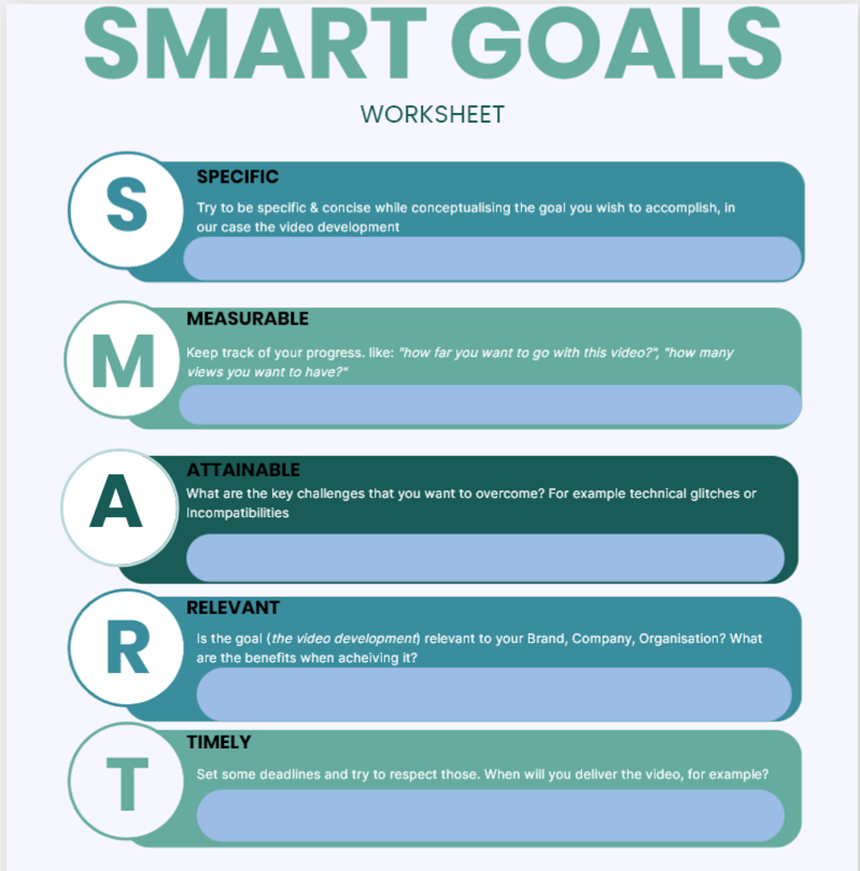
And then if you have confirmed that your Goals are actually SMART, then maybe you should ask yourself/eves whether you:
- can identify your target group – whom are you addressing to? This will affect your approach (formal, informal, informative/tutorial, funny etc.)
- have done enough preliminary research on the topic you wish to communicate. Either via articles, podcasts or videos, research is the baseline for being to the point.
- have identified the key words that represent the main idea of the video you are about to develop, for example alternative tourism.
- have decided what type of video you want to create, for example animation, live streaming, screen recording etc.
- have worked on the script and have also thought of the synchronicity of the text, adding subtitles etc.
- have found the perfect place to shoot your video, either indoors or outdoors, since this will suitably ‘frame’ your video
- have decided on which equipment to utilise: a mobile camera, a pro camera, a mobile phone etc.
- have established the perfect lighting; natural/day light or artificial lighting are the main two options to choose, depending on what you wish to focus on.
- have implemented a sound control
- are familiar with some video editing tools
- and last but not least you have done many rehearsals and you have filmed in small segments.
Tourism-oriented
approach:
Video creation might be a demanding thing to do, but do not feel
discouraged. There are plenty of junior developers out there that
could support your business or you yourself could attend some
training and cultivate a new skill! Why invest on Video
tutorials? Because
- it is a value for money; audiovisual content is more attractive than just script,
- it is the main power of social media,
- it brings visits to your website,
- it builds higher ambitions to your products and services.
4. Digital literacy (i.e., copying with misinformation, online safety and build cyber awareness or avoid malicious online information)
The pandemic highlighted the importance of Critical Thinking and cross checking all kind of information as well as their original source in order not to share fake news and mainly not to believe everything we read.
Tourism-oriented approach: When it comes to Tourism, Digital Literacy can be essential in terms of awareness and of a holistic overview of a service, a product or even a destination, local gastronomy etc. Why invest on Digital Literacy Skills? Because
- You need to be at least aware of the online challenges that could affect your online business
- You need to be able to respond to comments , especially online ones that could be based on fake news and misinformation regarding your company.
[1] https://digitalmarketinginstitute.com/blog/10-digital-skills-that-can-make-students-instantly-employable
[2] There is a module specially dedicated to Social Media, developed in the framework of this eLearning Tool
[3] Worldwide Daily Social Media Usage (New 2023 Data), https://explodingtopics.com/blog/social-media-usage
4. Digital marketing
The internet and emerging technologies are profoundly influencing the way we consume, interact, search, and learn in today's world. Digital marketing, a subset of marketing, aims to modify traditional marketing strategies, methods, and instruments to suit the constantly evolving digital landscape.
Digital Marketing involves utilizing the internet, mobile platforms, social media, search engines, and other digital platforms to target and engage with a specific audience.
Digital marketing is a popular approach for reaching a target audience because of the widespread use of the internet among consumers. Small and medium-sized companies have access to digital marketing, which provides better targeting capabilities and allows for personalization. Additionally, it utilizes advanced analysis and feedback tools to improve its performance and yield a higher return on investment (ROI). Digital marketing takes advantage of current consumer habits and offers endless customization options to meet the needs of the business. It can also be applied across various mobile platforms.
The main forms of digital marketing are (based on digital skills):
- The PPC advertising
PPC, or Pay-Per-Click, advertising is a popular digital advertising model where advertisers pay a fee each time their ad is clicked. It is a way to drive traffic to websites, increase brand visibility, and generate leads or sales. The most well-known platform for PPC advertising is Google Ads, but there are also other platforms such as Bing Ads, Facebook Ads, and Twitter Ads that offer PPC advertising options.
In PPC advertising, advertisers set up campaigns by selecting keywords, defining a target audience, setting a budget, and creating compelling ad copies. When a user performs a search or visits a website, an ad auction takes place, determining which ads will be displayed and in what order based on factors like bid amount, ad quality, and relevance. Advertisers select relevant keywords and set a maximum bid amount, which represents the highest amount they are willing to pay for a click on their ad. The ad's position in the auction is determined by the bid amount and other factors.
When a user's search query or website visit matches the keywords selected by the advertiser, the ad is eligible for display. The ad appears alongside organic search results or within websites and social media platforms as sponsored content. Advertisers are only charged when a user clicks on their ad, and the cost per click (CPC) may vary based on competition and ad quality. Advertisers have control over their budget and can set spending limits.
PPC advertising offers immediate results, targeted advertising, measurable performance, and cost control. It allows businesses to reach their target audience, increase online visibility, and achieve marketing goals. Advertisers can track campaign performance and make adjustments to optimize their results by refining keywords, ad copies, or targeting parameters.
Overall, PPC advertising is an effective digital marketing strategy that provides businesses with a means to reach their audience, drive traffic, and achieve specific marketing objectives while maintaining control over costs and performance tracking.
- The social media marketing
Social media marketing is a powerful strategy used by businesses to promote their products, engage with their audience, and build brand awareness. It involves creating and sharing relevant content, running targeted ads, and actively interacting with users. By leveraging popular social media platforms, businesses can connect with a wide audience and benefit from features like audience targeting, influencer collaborations, analytics tracking, and social listening. Social media marketing offers benefits such as increased brand visibility, enhanced customer engagement, targeted advertising, and valuable consumer insights, making it a crucial component of a comprehensive digital marketing strategy.
- The email marketing
Email marketing is a form of direct digital marketing that utilizes emails to connect with a company's target audience. It entails sending out informative or promotional content with the aim of raising awareness about a product or brand and generating leads or sales.
In a company's marketing strategy, email marketing holds significant importance as it facilitates the development of customer relationships and ensures ongoing engagement with customers even when they are not making immediate purchases. As an email marketer, you are given the privilege of being a guest in your customer's inbox, which enables you to communicate with them on a more intimate and personal level.
- The content marketing
Content marketing refers to a strategic marketing approach that focuses on creating and distributing valuable, relevant, and consistent content to attract and engage a target audience. The goal of content marketing is to provide information, educate, entertain, or inspire the audience, rather than directly promoting a product or service.
Instead of using traditional advertising methods, content marketing aims to build brand awareness, establish credibility and trust, and ultimately drive profitable customer action. It involves creating various forms of content such as articles, blog posts, videos, podcasts, infographics, e-books, and more, tailored to meet the needs and interests of the target audience.
Content marketing relies on understanding the audience's preferences and interests, and delivering valuable content that addresses their pain points or provides solutions. By consistently delivering high-quality content, businesses can attract and retain a loyal audience, enhance their reputation as industry leaders, and increase the likelihood of converting audience members into customers.
Overall, content marketing focuses on creating and sharing valuable content to build relationships with the target audience, ultimately driving profitable customer action and contributing to the company's overall marketing objectives.
5. Digital communication
Digital communication pertains to a company's online communication endeavors. The use of digital communication allows us to remain connected with our loved ones, and has transitioned from being a luxury to a fundamental need in today's society. In the present era, digital communication has become an essential part of our daily lives.
Effective communication plays a crucial role in fostering trust between businesses and their clients, as well as conveying their requirements, aspirations, and difficulties more explicitly. Improving communication skills can enhance the client relationship and may lead to the acquisition of new business opportunities.
The communication between the companies and the customers can be achieved through:
- Chatbots
- Reviews
- Newsletter
- FAQ
- Social Networks
6. Digital applications in Tourism
Digitalization has a strong hold and impact and has clearly changed the way customers transact in and also purchase tourism products.
In the following we give some indicative examples of digital applications in the tourism sector. We have to stress that these examples are by no means exhaustive as new applications arise every day.
- Booking accommodation: There are numerous big platforms, such as booking.com, trivago.com, hotels.com etc., where one may book hotel rooms and search for last minute discounts. The hotel managers usually give to these platforms a certain number of rooms in their hotel and pay the platform a considerable commission for each room booked through them. This means that the platforms offer visibility and provide booking services to hotels but they reduce their profit margin. These platforms calculate automatically if there is still availability of rooms in a specific hotel after each booking.
Exercise: Please find a site promoting local tourism in a destination for this summer.
Booking services may also be provided by local tourism promotion sites, by local authorities, local development agencies etc., which additionally can provide information about restaurants, sightseeing, trip agencies, local culture etc.
Additionally, one may find rooms to let in the same platforms or in more dedicated platforms like the Airbnb. Airbnb has not only changed the approach to find accommodation when travelling for business or pleasure, but it has as well had a tremendous effect on the availability and prices of houses and apartments to rent to the local population.
- Booking or purchasing a ticket for travelling:
There are a lot of digital platforms where one may find good price offers for air tickets such as trip.com, expedia.com, booking com, cheapflights.com, kayak.com etc. Furthermore, all major airline companies have their own booking and purchasing digital system, they provide check-in service, special luggage, food or transfer order etc.
The same stands for most train companies, from which one may purchase tickets, book seats etc.
To buy a boat or ferry ticket one may also visit a dedicated site e.g. viva.gr and ferriesingreece.com in Greece.
Exercise : Can you find a website for purchasing a boats’ ticket in your country?
Local travelling: To digitally order a taxi and follow the course of the taxi is a major change in the sector and has caused a lot of debates on the status of these cars and persons employed.
There are digital applications about local bus schedules, train or metro schedules etc.
One may also book a car to rent digitally or combined with his/her airplane ticket with special discounts.
GPS systems, like google maps, provide a lot of information about routes, traffic but also sightseeing, restaurants, if they are open, if they are expensive, their telephone numbers, their rating. photos etc.
- Restaurants:
They may be found on the digital maps, local tourism websites etc. There are specific sites on may order food from a restaurant to be delivered home, at their hotel etc. Many restaurants have also their specific digital service taking orders for delivery.
Exercise: Can you state 2 food delivery sites in your city?
7. Reading materials
- https://single-market-economy.ec.europa.eu/sectors/tourism/support-business/digital_en
- https://www.unwto.org/digital-transformation
- https://www.researchgate.net/publication/353464172_Tourism_Industry_Digital_Transformation
- https://www.jesoc.com/wp-content/uploads/2020/07/JESOC15_310.pdf
- http://blog.wearedrew.co/en/digital-transformation-in-the-tourism-sector
For Email Marketing
https://blog.hubspot.com/marketing/email-marketing-examples-list
For Video Creation
https://visme.co/blog/video-tips/