Theory: (Digital) Social Skills
| Site: | DIGITOUR Training Platform |
| Course: | Building Digitalisation Readiness in the Tourism SME Sector - ENGLISH |
| Book: | Theory: (Digital) Social Skills |
| Printed by: | Guest user |
| Date: | Thursday, 24 September 2026, 9:35 PM |
1. Introduction
Socialisation and communication are key processes in the personal and professional lives of all of us, as they allow us to build lasting relationships based on mutual respect and understanding, to share concerns or interests, or to communicate a powerful idea to our audience.
Nowadays, these processes have gradually moved online, where thanks to the use of social networks or digital tools such as email or video calls, a person can connect with someone 5000 km away, or communicate a product/service offer to an increasingly large potential online audience. That, also being boosted by globalisation and international tourism trends worldwide.
Therefore, knowing and being able to apply social strategies is already essential for tourism professionals in Europe, and their mastery of digital communication will be a competence of great interest to companies and employers.
This module aims to provide basic competencies and tools on digital social skills that will enable (future) professionals in the sector to build and strengthen their relationships with stakeholders and customers. However, bear in mind that due to the ever-changing nature of digital advances and IT progress, some of the information provided within this Module can potentially be out of date in years to come.
2. Social Skills - What & Why?
Social skills are part of what are known as "soft skills", which, in turn, refer to those social, emotional, resolutive and behavioural skills that allow us to perform better in social contexts and, therefore, obtain better results.
In the context of DIGITOUR, “Social Skills” are particularly relevant in the digital environment, since it is the new playing field on which companies in the tourism sector, regardless of their particular area of activity, must focus in order to attract customers and maintain good relations with stakeholders. This not only facilitates innovation, but also improves the resilience prospects of small businesses and professionals.
However, it is impossible to ignore the benefits of applying soft skills (communication, teamwork, empathy, active listening, collaboration, etc.) in daily activities that require presence, as they will be the key to a successful performance and the achievement of better results (such as strengthening relationships or customer loyalty) in the short, medium and long term.
According to DIGITOUR's previous research, social skills - such as communication or relationship management - are essential for professionals and SMEs in the tourism sector in the daily management of their activities and, therefore, being able to apply appropriate strategies in the (increasingly) digitalised environment will be fundamental. Therefore, this Module aims to provide basic theoretical knowledge and practical and easy-to-apply strategies to boost their performance.
Additionally, social skills usually go hand in hand alongside one’s own methodological skills, so head to Module 4 to learn more on the topic.
3. Communication skills
An essential part of social skills are the communication skills, which allow you to make and deliver a suitable message to the receiver/audience, as well as equip you with the competences to be able to actually listen to their needs and expectations, and use that data for decision taking.
You can find more insightful information on the relevance of information skills - either as soft or methodological-wise - within DIGITOUR Module 4. Methodological Skills.
Some of the most important communication skills when dealing personally with clients, colleagues or stakeholders relevant to your activity (suppliers, collaborators, public bodies, etc.) are:
● Empathy
● Storytelling & Persuasive presentation skills
To learn more about these most desired communication skills that have a great impact on your professional performance, you can watch this video:
And, visite the following article to learn more on simple strategies to enhance your communication in the hospitality/tourism industry, specifically: 9 Tips to Improve Communication in the Hospitality Industry
Note that communication can happen in either face-to-face or digital environments, and each scenario happens to have its own specificity when it comes to exchanging information. Within the DIGITOUR framework, we’ll focus on digital communication skills for solo-entrepreneurs/SMEs.
3.1. Digital Communication

Source:
Business Technology Ciudad - Foto gratis en
Pixabay
Digital communication has its own particularities compared to face-to-face communication.
For example, online interaction with customers eliminates the elements of non-verbal communication (tone of voice, gestures, etc.), which can create new challenges in the communication process.
Did you know that, according to researcher Albert Mehrabian, 65% of communication is non-verbal?
Digital communication implies having the ability to be able to engage in conversations and relationships with others in the digital world in a professional manner. Being aware of how and when to send messages, communicate, send attachments, with an appropriate channel and format; all this without neglecting the rules of internet politeness.
This includes areas such as asynchronous communication, which is live but remote communication, such as video conferencing, meets, and so on.
One of the great benefits of digital communication is that, in addition to allowing individual interactions with teams, suppliers or (potential) customers, it allows a message, offer or idea to be communicated to a large number of people with an online presence. In this way, it is a basic marketing tool for any company or professional.
To learn more on the basics of digital communication, have a look at the following video:
3.2. Communication Strategies
Communicating with other actors allows us to get to know other perspectives and share experiences and interests, which is a basic pillar in building personal/professional relationships.
But also, communication skills play a very important role in communicating an offer or idea, which is key for small business in a highly competitive sector such as tourism.
For example, reflect on the following situations:
a) You are planning to start your own tour guide agency together with some fellow students, but you need funding and contacts to start your venture.
- How do you think you could start establishing professional relationships with relevant actors in your area?
- What kind of pitch would you need to design in order to solicit investment in your idea? How could you achieve the expected impact? What elements of communication will be key to achieve it?
b) You are going to launch a good package of tourist experiences to the market, and you want to make a digital marketing campaign in social media to communicate it.
- What kind of message will be most suitable for your target audience?
- What characteristics will the message have to be shared in the digital sphere?
- Will SEO be a factor to take into account in your communication? If so, how?
This is where persuasive communication strategies come into play, i.e. strategies aimed at achieving specific objectives.
Persuasive communication strategies are employed with the intention of achieving a desired result. Therefore, the first step to strategic communication is to identify what your objective is and then apply the right tools and approach to achieve it.
We suggest you watch the following video to understand in a simple way what strategic communication is and how you can apply it as an element of persuasion.
Some of the online applications of this type of communication can be found in the following circumstances.
i. Digital Marketing
To learn more about the implications and benefits of Digital Marketing in your professional activity, we strongly recommend you to take a look at Module 5. Digital Marketing of the DIGITOUR online training programme.
Likewise, to learn more about how to manage the digital presence of tourism companies and professionals in social networks, we recommend you to learn with the Module 6. Online Presence & Social Media.
ii. Negotiation
Following the Business Dictionary’s definition of “negotiation”, this is understood as “bargaining (give and take) process between two or more parties (each with its own aims, needs and viewpoints) seeking to discover a common ground and reach an agreement to settle a matter of mutual concern or resolve a conflict.” And we do negotiate all the time– it is the method we use to settle differences in our personal and professional lives!
Therefore, negotiating is a key process for any entrepreneur or professional. It can be key when setting the price of your offer, closing contracts with suppliers or establishing collaboration agreements with other relevant actors and stakeholders in your ecosystem to co-design or co-create innovations.
Moreover, negotiation processes are common in our daily lives, so knowing the basic principles that govern these interactions (as well as always keeping in mind what our vision, mission, values and objectives are) is a key skill.
To learn more about communication in a negotiation process:
● We recommend you take a look at the playlist below to learn more about the basic principles of negotiation and how to manage them:
● The following playlist will allow you to observe different negotiation strategies in practical contexts:
●
iii. Sales
Did you know that 87% of tourists around the world do use the internet to plan and organise their trips?
It is for this reason, among others, that having a good online sales strategy (digital marketing and online sales channels suitable for your offer) is of fundamental relevance for the operation of your tourism business or professional activity.
Key elements that you need to take into account in your online communication and relationship with customers are:
● Pay attention to keywords to optimise your organic SEO positioning in online search engines. To keep up to date with the most relevant keywords and use them in your online communication, you can use search engines such as: Popular Travel Keywords | WordStream
● Whenever possible, support the communication of your product/service offer or experience with audiovisual materials. In general, it has been shown that inspirational videos or images tend to generate higher engagement with potential customers and increase the likelihood of sharing your post (so you can potentially reach more people).
● Be aware of your target's attention spam! Your social media communication should be clear, concise and engaging so that it is quickly digested and attracts attention. Including questions, CTAs or gamification elements can be interesting to reinforce your message.
● When communicating by email or video call (e.g. in the case of tour operators), always respect the rules of netiquette - more on this below - and, when in doubt, use a formal register.
● The communication of your tourism offer should be coherent and consistent across all online access platforms you have (website, social media, blog, third-party advertisements, etc.).
● For sales to be successful, remember that it will be key to provide adequate customer service. To do this, having simple and easy-to-access contact channels is essential. Customers should be able to contact you through different channels, and expect to receive a response in a short period of time and that you resolve their doubts or needs efficiently.
● Also, social media and online communication tools provide a great opportunity to engage with your audience in meaningful ways. Whether it is by politely replying to their comments and questions in your cooperative posts, to have conversations with them to learn more about their expectations. Use your profiles wisely and create a community for your offer!
iv. Networking
Effective communication is a key tool for professional networking, and networking is a key activity for any entrepreneur or small business that wants to grow its business and collaborate with relevant stakeholders in its ecosystem.
Digital communication is the vehicle by which in most cases the foundations of a future professional relationship are established nowadays, so applying a communication strategy effectively aligned with your objectives will be of great relevance.
You can learn more about networking and collaboration with others in Module 11 of the DIGITOUR training programme.
3.3. Netiquette
So now you know the importance of digital communication for your initiative, and you are able to depict different situations in which to apply your skills, but… how to do it properly?
Just as it is advisable to follow an "etiquette" or code of behaviour considered appropriate and desirable in personal interactions with customers or other stakeholders, there are also rules to be observed in online communication.
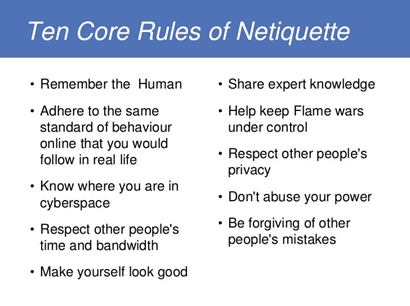
These are known as netiquette, and can be summarised as follows:
● Be clear and honest. Your online communication should respect your offline values. This implies, for example, maintaining the same standards of respectful behaviour that you would have in real life. It should also be consistent with the message to be conveyed and your own communicative/relational style.
● Always use an appropriate linguistic register (formal/semi-formal) in written communication contexts (e.g. emails or professional networking forums) or oral communication contexts (e.g. video meetings or video messages).
● Respect the privacy and time of others. Try not to bombard people with requests for contact or instant messages. Respect their boundaries and maintain a friendly and patient posture.
● Adapt your message or style to the medium you are in. While you should always maintain consistency and integrity when communicating in the online environment, you may not respond the same way to a comment from a professional friend on your LinkedIn post as you would to a formal email requesting information about a new group tourism experience.
Source: Netiquette
To learn more about rules of netiquette, please read the following: Netiquette Guidelines - Columbus State University
3.4. Intercultural Communication Skills
As a further effect of globalisation and the democratisation of tourism, it has become a major player in international trade and an essential part of the GDP of many countries around the globe, feeding synergistically into other sectors of activity (according to UNWTO).
This internationalisation of tourism brings with it the arrival of thousands and thousands of international tourists to and between EU countries, which brings its own particular challenges for small businesses and professionals in the sector.
In this sense, it is possible to affirm that communication in foreign languages (to accommodate customer demands) and the need to be able to detect cultural barriers and implicit biases in dealing with people from other cultures will be competences and skills of great value.
i. Knowledge in foreign languages
Another of the main concerns identified among tourism professionals during the preparation phases of DIGITOUR in the partner countries was the need for (future) tourism workers to have the necessary knowledge and skills to communicate effectively with (potential) customers in other languages.
As in the case of face-to-face communication, English is also the language of reference in many of the communications with international clients (both European and from third countries), which is why correct language literacy will be a key factor for the success of a professional.
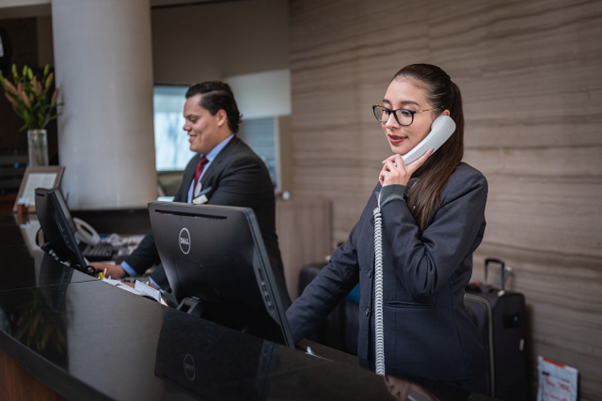
In this sense, and taking into account the possibilities and limitations of the communication that takes place in the digital environment, writing skills in English will be a priority. In this way, it will be possible to respond appropriately to queries and requests that arrive by email, or through online presence channels such as a company's corporate website or its social media profiles.
This does not imply that knowledge of a language (or several languages) should be limited exclusively to reading and writing skills, since once communication moves to the physical environment, then oral communication will be equally important to ensure the satisfaction of the interlocutor.
Source:https://pixabay.com/es/photos/recepcionistas-llamada-de-tel%c3%a9fono-5975962/
Some (online) tools that can be useful for non-native English speakers are:
● Professional translation services - even though online translators might have a positive impact on your communication needs with foreigners (such as Deepl, Google Translator, Reverso, etc.), collaborating with a professional translator might be key for your online presence. Consider the pros of having a perfectly correct website and/or blog in the most common languages (i.e., English, Spanish, Chinese, French, etc.) - depending on your main targets - and invest in added value.
● Open Culture - this online repository of MOOCs for language learning based on free audio and video courses on iTunes or YouTube can be your best tool to increase your language knowledge in a flexible and adaptable way to your training needs.
● TripLingo - Not only a language translation app, but TripLingo also takes a more holistic approach by enhancing customers' experience. The app offers up a currency converter, culture crash course, and common phrases of local people.
● SayHi - this app allows you to record the user's voice, then users can play their translation in the voice of either a woman or a man.
● Speak & Translate - Translator on the App Store - similarly to previous tools, Speak & Translate provides an easy and convenient digital solution for in-real time translation in both speaking/written form.
You can learn more on digital solutions to boost your English competences and provide better solutions for international travellers here: 8 Tools That Can Ease the Language Barrier for Business Travelers - 30SecondsToFly Inc.
ii. Intercultural Communication
In addition to the theoretical and practical knowledge of other languages to facilitate the exchange of communication with (potential) customers or other stakeholders, as well as to be able to communicate one's own offer through different digital channels, it is also necessary to be aware of intercultural communication as a professional.
According to the Council of Europe (2008), intercultural communication refers to “a process that comprises an open and respectful exchange of views between individuals and groups with different ethnic, cultural, religious and linguistic backgrounds and heritage, on the basis of mutual understanding and respect. It requires the freedom and ability to express oneself, as well as the willingness and capacity to listen to the views of others. Intercultural dialogue contributes to political, social, cultural and economic integration and the cohesion of culturally diverse societies. It fosters equality, human dignity and a sense of common purpose. It aims to develop a deeper understanding of diverse world views and practices, to increase cooperation and participation (or the freedom to make choices), to allow personal growth and transformation, and to promote tolerance and respect for the other”.
Therefore, the ability to communicate respectfully and meaningfully across cultures is of key relevance in building relationships with international clients and stakeholders, who may not share the cultural background of your company or team.
Some barriers to overcome when communicating and establishing relationships with people from other cultures are:
● Implicit bias and prejudices, ethnocentrism & stereotypes - learn more on them here: 2.3: Barriers to Intercultural Communication - Social Sci LibreTexts
● Language barriers. Obviously, language is an issue when communicating with people from different parts of the world. Also this is especially important in terms on non-verbal communication (when face to face), as different gestures or body language’s significance might vary from place to place, which can lead to misunderstandings.
● Psychological preferences that depict one’s own natural tendencies towards certain attitudes or topics. This is quite related to implicit bias and management/leadership/communication styles differences among cultures. It’s not always easy to go against your natural will, but being open to understanding and learning from other perspectives can also be an enriching opportunity for upskilling.
Aiming to overcome these barriers, the following 5 attitudes, among others, are very important for effective intercultural communication to take place (M. Rodrigo, 1999):
● Interlocutors need to be motivated to get to know the other culture and show empathy with it;
● They are aware of their own culture and its communication processes;
● Parts pay attention to the elements that are part of non-verbal communication (when happening offline);
● Misunderstanding might be a part of any given intercultural encounters, so bearing that in mind can help professional to deal with the conflict more effectively;
● It is also important to be able to interpret the meaning and ultimate intention of their interlocutors’ words (i.e. to negotiate not only the meaning of the message but also its elocutionary force).
3.5. Good practices
An example of good practice in the application of digital communication skills in the tourism sector could be the following:
Analysis of Effective Digital Communication in Travel Blog Business Models
You can use this example to see what good practices you can transfer to your daily work and inspire you to take advantage of new opportunities for training and professional growth.
However, it is just as important to learn from successes as it is to learn from past mistakes. Therefore, we suggest that you spend some time recalling a situation in which you have had to use your communication skills (preferably in the digital environment) and you were not satisfied with the interaction.
4. Relationship management
The management of professional relationships is key in highly volatile and changing sectors, such as the tourism sector, which is so susceptible to trends.
Therefore, here are two key elements or processes that can be useful to you when building solid relationships with your (future) target clients: 1) relationship building; 2) maintenance.
They are not independent or exclusive processes, but complementary and as such should be integrated within an organisation.
Within our framework, we’ll focus on how to deal with relationships involving two of your main target groups: clients & stakeholders.
4.1. CRM
CRM or Customer Relationship Management usually refers to software for managing commercial strategies, practices and technological solutions that are focused on a company's relationship with its clients.
More generally, and in accordance with the DIGITOUR training framework, we can understand CRM as the business management model that puts the customer and your relationship with him/her at the centre of professional activity. In other words, the focus is on the needs and demands of your target markets, as well as on what you offer, how you offer it and by what means.
You can learn more on CRM and digital solutions on Module 8. CRM.
4.2. Customer support & Conflict Management
Customer loyalty is nothing more than the result of a correct customer service strategy, which is becoming more and more complicated in a globalised VUCA environment.
3 key aspects to provide an excellent quality and responsive service are:
- Personalised advice.
- Follow-up of each incident.
- Defence of the interests and rights of each client.
These key moments or stages in the resolution of a (potential) conflict must always be supported by communication strategies appropriate to the specific case. To learn more on that:
●
●
Remember that in today’s state of the sector, most of these conflicts might happen online. For instance, via comments on social media corporate profiles and/or forums for tourist recommendations. Therefore, keep vigilance on your business online persona would be really advisable in order to be able to:
a) Provide answers to customers/collaborator queries online and/or comments on social media. Do bear in mind to respect netiquette!
b) Build up your business personal brand based on high-quality performance and conflict prevention (i.e., by providing as much information on your product online beforehand, using your social media presence to gather relevant information about clients, etc).
In any case, customer service and the efficient and satisfactory management of possible conflicts is essential to ensure the satisfaction of your company's customers. On that note, a useful tool for measuring the level of customer satisfaction is: CSAT
Ensuring customer satisfaction can, in turn, have repercussions in terms of:
● Solidifying company/customer relationships, which promotes customer loyalty.
● One of the major conversion funnels in the tourism sector is word-of-mouth recommendation. This can be through personal recommendations among family and friends, or through positive online reviews and comments. Therefore, a satisfied customer can generate new sales.
● Customer satisfaction helps you to establish yourself as a benchmark in your local industry. Whether you are a professional or an entrepreneur, this will open new doors for you in the future, e.g. for collaborative processes with others.
4.3. Ecommerce/ Social Media Management
The reputation of a company, person, product or service on the internet and its digital platforms. This online reputation is affected by the content an organisation distributes, reactions and interactions with web users, activity on social networks. Etc.
For e-commerce brands or SMEs selling online, digital reputation is very important. It can affect the credibility and visibility of your online shop.
This is therefore closely related to the management of your business' online presence (see Module 6 for more information on this) and your digital marketing strategy (see Module 5 for more information on this).
4.4. Stakeholders Relationship Management
As we have already pointed out, in addition to being able to communicate and engage effectively with your customers, as a tourism professional you must be able to collaborate with other actors in your ecosystem.
Think, for example, of service providers for your accommodation, suppliers of raw materials for your traditional food restaurant or a potential partner with whom you want to collaborate to offer new leisure activities in the region.
Well, in this case, both soft skills and methodological skills will be key in your management of professional relationships with others, both online and offline.
In your relationship with stakeholders/collaborators you will also have to take into account:
● Your online presence - communicating your message and objectives will be key when networking online and contacting potential collaborators in the online environment.
● Conflicts can also arise in B2B relationships with other professionals, so being able to apply communication skills such as active listening will help you to resolve the situation.
● Just as you can measure your customers' satisfaction with your offer, it would also be interesting to apply methodologies to measure stakeholders' satisfaction with your collaboration, in order to identify strengths and areas for improvement.
In any case, to learn more about how and why to collaborate with other actors and how to network effectively, we recommend that you take advantage of the contents of Module 11 of the DIGITOUR training programme.
5. Collaboration
One of the most relevant soft and social skills in today's tourism landscape is the ability to collaborate effectively and meaningfully with others, and the creation of win-win situations for the different parties involved in the collaboration.
Of course, for a collaborative process to be successful (regardless of its duration in time or the objectives pursued), it will be necessary to establish communication strategies based on honesty and clarity. Likewise, being able to engage in persuasive strategies will be helpful.
5.1. Good Practices
Especially to learn more about the vital importance of applying social skills in collaboration with colleagues in the workplace (teamwork), you can read more at: Examples of Communication and Collaboration Skills | Indeed.com Australia
However, to learn more about the benefits of collaboration and how to network with other professionals/companies/stakeholders, you can refer to Module 11 of the DIGITOUR training programme.