Theory: Digital Marketing
| Site: | DIGITOUR Training Platform |
| Course: | Building Digitalisation Readiness in the Tourism SME Sector - ENGLISH |
| Book: | Theory: Digital Marketing |
| Printed by: | Guest user |
| Date: | Friday, 25 September 2026, 4:20 AM |
1. Introduction: Digital marketing and its importance in today's business world.
Digital marketing is the process of using digital channels such as websites, search engines, social media, email, and mobile applications to promote products and services. It is an essential part of today's business world, as it allows companies to reach a wider audience and build relationships with customers. Digital marketing helps businesses to increase their visibility, reach more potential customers, and generate more leads and sales. It also helps to build brand awareness and loyalty, as well as to measure and track the success of campaigns. As part of the Tourism Sector, you will find that your country and regional tourism bodies plan and how they execute it has been designed to help you become visible on the global marketplace. As part of their campaigns, they offer tools and supports that can help blend and shape your strategy to define your bespoke offering.

2. The Benefits of Digital Marketing
- Increased Reach: Digital marketing allows businesses to reach a much larger audience than traditional marketing methods. With digital marketing, businesses can target specific audiences and reach them in a more cost-effective way.
- Cost-Effectiveness: Digital marketing is much more cost-effective than traditional marketing methods. Digital marketing campaigns can be tailored to specific audiences and can be tracked in real-time, allowing businesses to make adjustments as needed.
- Measurability: Measurability in digital marketing refers to the ability to track and measure the performance of digital marketing campaigns. This includes tracking the number of visitors to a website, the number of leads generated, the number of conversions, and the amount of revenue generated. Measuring the success of digital marketing campaigns is essential for understanding the effectiveness of the strategies used and for making informed decisions about future campaigns.
Listening to the most important people in your business, your customers, and understanding what you need to know and what is valuable data will be of benefit and take out what is classed as white noise. Remember you have other work to take care of, so capture the information of value making sure it is current, relevant, and up to date.

2.1. Cost effectiveness
Cost Effectiveness: review your spend to date and set your budget.
A marketing budget is the amount of money allocated to promote a product, service, or brand. It is typically allocated on an annual basis and is used to cover expenses such as advertising, public relations, promotions, and research. The budget should be based on the company's overall marketing strategy and objectives. It should also be flexible enough to accommodate changes in the market or unexpected opportunities.
2.2. Measurability
Measurability: The three options to change your budget spend.
The reason for increasing or decreasing a marketing budget depends on the goals of the business. If the business is looking to increase sales, then increasing the marketing budget may be necessary to reach more potential customers. On the other hand, if the business is looking to cut costs, then decreasing the marketing budget may be necessary to reduce expenses. The other option is to retain the status quo.
3. Keywords to help you understand marketing and digital marketing jargon
Traditional Marketing
Traditional marketing is a form of marketing that uses traditional media such as print, television, radio, and direct mail to reach potential customers. It is a form of marketing that has been used for many years and is still used today. Traditional marketing is often used to create brand awareness, promote products and services, and build customer loyalty. It is also used to target specific audiences and to create a lasting impression. Traditional marketing can be used to reach a wide range of customers.
Content Creation
Creating content for your marketing campaigns is essential for any business. Content helps to engage customers, build trust, and establish your brand as an authority in your industry. Content can also help to drive traffic to your website, increase conversions, and generate leads. Content can also be used to educate customers about your products and services, and to build relationships with them. Content can also be used to increase brand awareness and to create a positive customer experience. Content can also be used to increase visibility in search engines.
Marketing Campaign
A marketing campaign is a coordinated series of activities that promote a product, service, or cause. It typically includes a combination of advertising, public relations, promotions, and other marketing activities. The goal of a marketing campaign is to reach a specific target audience and to achieve a desired outcome, such as increased sales or brand awareness.
Social Media Channels
Facebook, Twitter, Instagram, YouTube, Snapchat, TikTok, and Influencers. (Click here to go to our Social Media Module).
Email Marketing
Email marketing is a form of direct marketing that uses electronic mail as a means of communicating commercial or fundraising messages to an audience. In its broadest sense, every email sent to a potential or current customer could be considered email marketing. It usually involves using email to send advertisements, request business, or solicit sales or donations, and is meant to build loyalty, trust, or brand awareness. Email marketing can be done to either cold lists or current customer database.
Pay Per Click
Pay-per-click (PPC) is an online advertising model in which advertisers pay a fee each time one of their ads is clicked. Essentially, it’s a way of buying visits to your site, rather than attempting to “earn” those visits organically. Search engine advertising is one of the most popular forms of PPC. It allows advertisers to bid for ad placement in a search engine’s sponsored links when someone searches on a keyword that is related to the item or service you have posted for sale.
Integrating SEO Tracking
Integrating SEO tracking into your website can help you understand how your website is performing in terms of organic search engine rankings. It can also help you identify areas of improvement and track the progress of your SEO efforts. SEO tracking can provide valuable insights into how your website is performing in terms of organic search engine rankings, which can help you make informed decisions about how to optimize your website for better visibility and higher rankings. Additionally, SEO tracking can help you identify potential issues with your website.
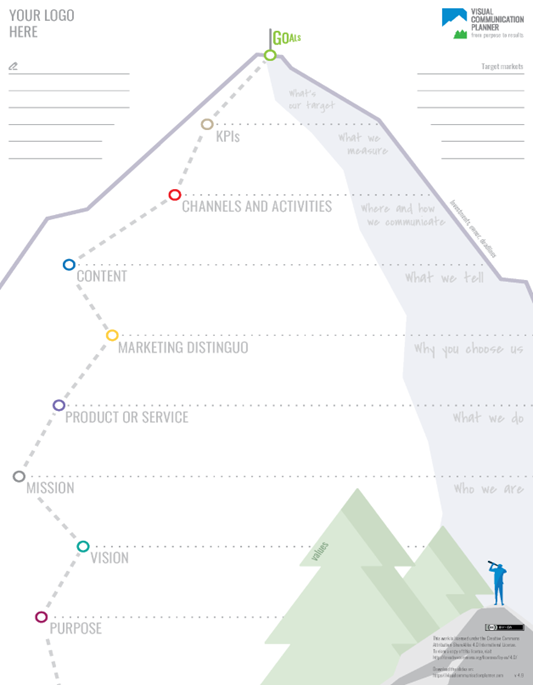
In our research we found this template to be a clear and concise way to build your plan. To download this template, you can access it via this link: https://visualcommunicationplanner.com
4. Reading materials and links
https://prsmith.org/books/?trk=public_post_share-update_update-text
https://visualcommunicationplanner.com
https://www.oxfordreference.com/display/10.1093/oi/authority.20110803100043628
Disclaimer
The developing organisation of this module has no direct or indirect business relationship with commercial products given as examples. Please check costs and suitability to your business before engaging with any commercial platform.