Completion requirements
View
2. What is Business Intelligence?
BI Definition- A set of theories, methodologies, processes, architectures, and technologies that transform raw data into meaningful and useful information for business purposes.
Business intelligence (BI) software are the tools that make it possible to create value from available business data. BI tools turn raw data, generated in everyday business transactions, into meaningful and actionable information that can be used for taking quick and smarter business decisions.
Business intelligence (BI) process support decision making allowing tourism entrepreneurs to better understand, analyse and predict the future inside and outside of their businesses. In order to achieve Business Intelligence, i.e. to get actionable information from raw business data, it is necessary to go through some basic steps presented in the logical architecture of a BI system.
BI is helpful for tourism businesses of all sizes and industries.
- Turning raw data into actionable business information
- Taking timely, smarter and informed managerial decision
- Better understanding the customers and delivering exemplary customer experiences
- Increasing productivity by spending time on what is important.
- Empowering employees and transparent collaboration
EXAMPLE – A chain of hotels Accommodation can be booked by phone or online booking.
- Issues loyalty cards to its customers - a tool that links all bookings no matter how they are booked - unique account number
- Collects data about the customer purchases into the company database.
What can the hotel understand by analysing the data with BI?
- The loyalty of specific customers to the hotel brand
- The bookings they make, when they travel and whether for vacation or work, whether they travel single, as a couple or with family
- Their preferences
What are the benefits for the hotel?
- The tools to understand or even predict customer needs, preferences, and habits.
- Anticipating new opportunities to sell, deliver better service, providing better targeted marketing campaigns.
A Business Intelligence dashboard (BI dashboard) is a data visualization and management tool that displays on a single screen the status of business analytics metrics, key performance indicators (KPIs) and important data points for a business, department, team or specific process.
BI dashboards provide BI software interface for visualization and monitoring of preconfigured or customer defined metrics, statistics, insights into current data. It allows the business users of BI software to view instant results into the live performance state of business or data analytics. Every tourism company, even the smallest one, can benefit from introducing a Business Intelligence solution, because it is supporting the process of transforming data into information and then, information into knowledge usable for the company. BI Dashboards are very popular nowadays because they are much cheaper and affordable than ever before an there is a substantial growth of dashboard functionality and quality.
BI Dashboards allow business users to:
- Improve the efficiency of newly made decisions.
- Measure and constantly monitor company performance.
- Improve performed analysis due to visualization abilities.
- Recognize, localize, and analyse negative trends.
- Correct negative trends due to improved abilities for modifying concrete factors, affecting those trends.
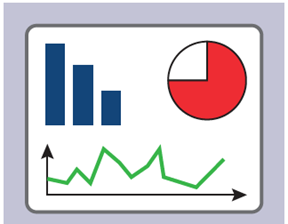
Visualization tools- When information is presented in a visual format, it allows users to more quickly perceive patterns that may not have been anticipated and to draw valuable conclusions more intuitively and rapidly. There are various visualization tools that can be used for graphically representing information, depending on its type and purpose: e.g.:
- Bar/Column charts for comparing values.
- Line charts for representing trends.
- Pie and Block charts for presenting ratios
- Scatter charts for presenting correlations
- Gauge charts and traffic lights for presenting KPI values and targets
Choosing the right visualization would make it possible to represent and interpret the data effectively.
free-icon.com
Business analytics is comprised of solutions used to build analysis models and simulations to create scenarios, understand realities and predict future states. Business analytics includes data mining, predictive analytics, applied analytics and statistics, and is delivered as an application suitable for a business user. These analytics solutions often come with prebuilt industry content that is targeted at an industry business process .”
https://www.gartner.com/en/information-technology/glossary/business-analytics
Business Metrics are quantifiable measures that are used to track and assess the status of specific business processes used by managers at different levels, executives and middle managers. to track all areas of business.
Business processes have specific performance metrics that are usually monitored, e.g.:
- Executives look at “the big picture” by using financial metrics.
- Sales experts monitor sales performance metrics such as new opportunities and leads
- Marketers track marketing and social media metrics, such as campaign and program statistics
Key Performance Indicators (KPIs) are measurable values that demonstrate how effectively a company is achieving key business objectives. Companies use KPIs at multiple levels to evaluate their success at reaching targets.
High-level KPIs may focus on the overall performance of the business. Low-level KPIs may focus on processes in departments such as sales, marketing, HR, support and others.