Requisitos de finalización
Ver
3. Communication skills
3.4. Intercultural Communication Skills
As a further effect of globalisation and the democratisation of tourism, it has become a major player in international trade and an essential part of the GDP of many countries around the globe, feeding synergistically into other sectors of activity (according to UNWTO).
This internationalisation of tourism brings with it the arrival of thousands and thousands of international tourists to and between EU countries, which brings its own particular challenges for small businesses and professionals in the sector.
In this sense, it is possible to affirm that communication in foreign languages (to accommodate customer demands) and the need to be able to detect cultural barriers and implicit biases in dealing with people from other cultures will be competences and skills of great value.
i. Knowledge in foreign languages
Another of the main concerns identified among tourism professionals during the preparation phases of DIGITOUR in the partner countries was the need for (future) tourism workers to have the necessary knowledge and skills to communicate effectively with (potential) customers in other languages.
As in the case of face-to-face communication, English is also the language of reference in many of the communications with international clients (both European and from third countries), which is why correct language literacy will be a key factor for the success of a professional.
In this sense, and taking into account the possibilities and limitations of the communication that takes place in the digital environment, writing skills in English will be a priority. In this way, it will be possible to respond appropriately to queries and requests that arrive by email, or through online presence channels such as a company's corporate website or its social media profiles.
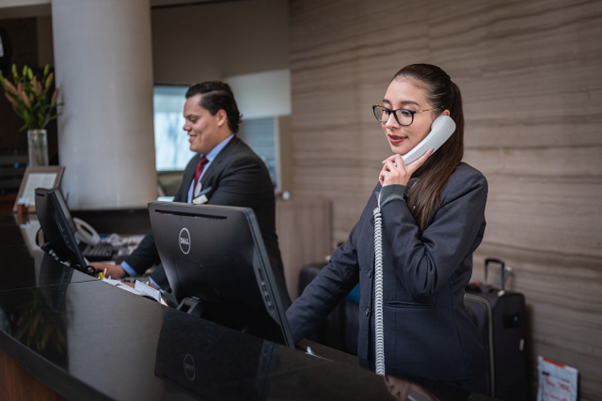
This does not imply that knowledge of a language (or several languages) should be limited exclusively to reading and writing skills, since once communication moves to the physical environment, then oral communication will be equally important to ensure the satisfaction of the interlocutor.
Source:https://pixabay.com/es/photos/recepcionistas-llamada-de-tel%c3%a9fono-5975962/
Some (online) tools that can be useful for non-native English speakers are:
● Professional translation services - even though online translators might have a positive impact on your communication needs with foreigners (such as Deepl, Google Translator, Reverso, etc.), collaborating with a professional translator might be key for your online presence. Consider the pros of having a perfectly correct website and/or blog in the most common languages (i.e., English, Spanish, Chinese, French, etc.) - depending on your main targets - and invest in added value.
● Open Culture - this online repository of MOOCs for language learning based on free audio and video courses on iTunes or YouTube can be your best tool to increase your language knowledge in a flexible and adaptable way to your training needs.
● TripLingo - Not only a language translation app, but TripLingo also takes a more holistic approach by enhancing customers' experience. The app offers up a currency converter, culture crash course, and common phrases of local people.
● SayHi - this app allows you to record the user's voice, then users can play their translation in the voice of either a woman or a man.
● Speak & Translate - Translator on the App Store - similarly to previous tools, Speak & Translate provides an easy and convenient digital solution for in-real time translation in both speaking/written form.
You can learn more on digital solutions to boost your English competences and provide better solutions for international travellers here: 8 Tools That Can Ease the Language Barrier for Business Travelers - 30SecondsToFly Inc.
ii. Intercultural Communication
In addition to the theoretical and practical knowledge of other languages to facilitate the exchange of communication with (potential) customers or other stakeholders, as well as to be able to communicate one's own offer through different digital channels, it is also necessary to be aware of intercultural communication as a professional.
According to the Council of Europe (2008), intercultural communication refers to “a process that comprises an open and respectful exchange of views between individuals and groups with different ethnic, cultural, religious and linguistic backgrounds and heritage, on the basis of mutual understanding and respect. It requires the freedom and ability to express oneself, as well as the willingness and capacity to listen to the views of others. Intercultural dialogue contributes to political, social, cultural and economic integration and the cohesion of culturally diverse societies. It fosters equality, human dignity and a sense of common purpose. It aims to develop a deeper understanding of diverse world views and practices, to increase cooperation and participation (or the freedom to make choices), to allow personal growth and transformation, and to promote tolerance and respect for the other”.
Therefore, the ability to communicate respectfully and meaningfully across cultures is of key relevance in building relationships with international clients and stakeholders, who may not share the cultural background of your company or team.
Some barriers to overcome when communicating and establishing relationships with people from other cultures are:
● Implicit bias and prejudices, ethnocentrism & stereotypes - learn more on them here: 2.3: Barriers to Intercultural Communication - Social Sci LibreTexts
● Language barriers. Obviously, language is an issue when communicating with people from different parts of the world. Also this is especially important in terms on non-verbal communication (when face to face), as different gestures or body language’s significance might vary from place to place, which can lead to misunderstandings.
● Psychological preferences that depict one’s own natural tendencies towards certain attitudes or topics. This is quite related to implicit bias and management/leadership/communication styles differences among cultures. It’s not always easy to go against your natural will, but being open to understanding and learning from other perspectives can also be an enriching opportunity for upskilling.
Aiming to overcome these barriers, the following 5 attitudes, among others, are very important for effective intercultural communication to take place (M. Rodrigo, 1999):
● Interlocutors need to be motivated to get to know the other culture and show empathy with it;
● They are aware of their own culture and its communication processes;
● Parts pay attention to the elements that are part of non-verbal communication (when happening offline);
● Misunderstanding might be a part of any given intercultural encounters, so bearing that in mind can help professional to deal with the conflict more effectively;
● It is also important to be able to interpret the meaning and ultimate intention of their interlocutors’ words (i.e. to negotiate not only the meaning of the message but also its elocutionary force).