Completion requirements
View
3. Digital Competences & Skills
UNESCO’s definition of digital skills is “a range of abilities to use digital devices, communication applications, and networks to access and manage information. They enable people to create and share digital content, communicate and collaborate, and solve problems for effective and creative self-fulfilment in life, learning, work, and social activities.”
Digital skills encompass the competencies and knowledge needed to effectively use digital devices, applications for communication, and networks in order to access and manage information.
The digital skills are important because:
- The significance of digital skills lies in the fact that the COVID-19 pandemic expedited an already rapid pace of digital transformation.
- In present times, the internet has become a fundamental aspect of our daily lives
- The acquisition of these skills is crucial for the survival of businesses.
- They are the foundation of a company's digital transformation.
Here are some indicative digital skills that could be useful for students and employees , especially those that are somehow engaged to the Tourism sector [1].
1. Managing Social Media [2](i.e., developing
content, creating profiles for professional purposes, exploiting
Podcasts for dissemination purposes etc.). Tourism-oriented approach: Social Media are the most
direct & effective way of reaching your audience nowadays.
The average person spends 2 hours and 27 minutes on social
media every day[3]. In simple
words, potential customers are out there scrolling on Instagram
or Tik Tok on where to travel, on gastronomy tips and cheap
opportunities. Why not reach them to present your services? They
may become your actual customers.
2. Email Marketing (i.e., newsletters, mail campaigns). This is a way to reach your audience/customers and sharing news about your products and services, updates, discounts etc. When we refer to tourism for example, the most common email marketing would be to communicate a travel offer or a new destination, service that you are now able to offer.
Let’s see how you could easily run a successful campaign based on Email Marketing.
A. First you need to remember that this method is a way of being (and remaining) in contact with your (potential) customers, so the message shared needs to be concrete and clear.
B. Secondly, you need to create a mailing list with the right subscribers per case/campaign. You should continuously make efforts to keep your mailing lists updated and to enrich them with new subscribers. Please keep in mind that in the case you send e-mails or newsletters to individuals, at the first place you have to have their consent to do so.
C. Next step: you need to set your goals and clarify what you wish to achieve via this campaign. It could be to
- spread the news about something new,
- disseminate an achievement that your team is proud of,
- share some new services/products,
- promote sales/discount.
D. Then you just need to spend some time in order to customize (or even better personalize) your email campaigns. You need to stay connected with your audience, so the best way to do this is by addressing them with their names.
E. Visualise the campaign. Plein texts are no longer engaging ones. Be in line with your brand/logo and create a strong synapsis in their brain.
F. Spend time on optimization: Your campaign should be responsive and compatible with various devices, not only laptops but mostly mobile phones and tablets.
G. Integrate a Call-To-Action button, in order for your campaign to have a point. What do you wish to say to your subscribers? This button should redirect them somewhere – this trip needs a final destination, after all!
There are plenty of Email Marketing Solutions, such as Mailchimp, Brevo etc. that could support you on your first steps.
Tourism-oriented approach: Why invest in Email Marketing in the first place? Because:
- It has a massive impact on relevant stakeholders, potential customers, especially young people, who are so familiar with digital environments,
- It establishes a concrete network with stakeholders and customers,
- It brings awareness on new products and services,
- It reminds your brand to people,
- It is a low-cost campaign.
The impact might be bigger than you think as soon as you do not “bomb” people with continuous email that will eventually end up in Spam folder. You need to have something to share with your audience and you need to build a strategy for at least the following 6 months, so that people will learn your products and services only when they are competitive, innovative or a ”catch” in your market.
3. Video Creation i.e., presentation of your services, of customers making use of these services and being satisfied from them etc. / using videoconference features (i.e., recording, editing, rendering)
Here are some tips for making an engaging video; no technicalities, just preparation.
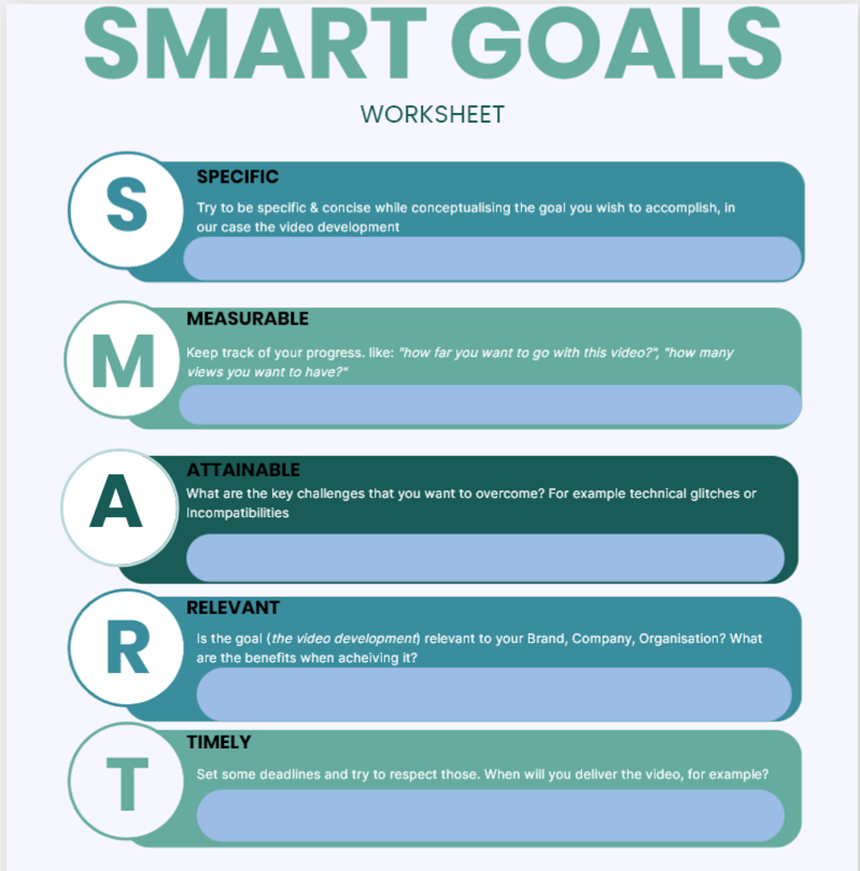
And then if you have confirmed that your Goals are actually SMART, then maybe you should ask yourself/eves whether you:
- can identify your target group – whom are you addressing to? This will affect your approach (formal, informal, informative/tutorial, funny etc.)
- have done enough preliminary research on the topic you wish to communicate. Either via articles, podcasts or videos, research is the baseline for being to the point.
- have identified the key words that represent the main idea of the video you are about to develop, for example alternative tourism.
- have decided what type of video you want to create, for example animation, live streaming, screen recording etc.
- have worked on the script and have also thought of the synchronicity of the text, adding subtitles etc.
- have found the perfect place to shoot your video, either indoors or outdoors, since this will suitably ‘frame’ your video
- have decided on which equipment to utilise: a mobile camera, a pro camera, a mobile phone etc.
- have established the perfect lighting; natural/day light or artificial lighting are the main two options to choose, depending on what you wish to focus on.
- have implemented a sound control
- are familiar with some video editing tools
- and last but not least you have done many rehearsals and you have filmed in small segments.
Tourism-oriented
approach:
Video creation might be a demanding thing to do, but do not feel
discouraged. There are plenty of junior developers out there that
could support your business or you yourself could attend some
training and cultivate a new skill! Why invest on Video
tutorials? Because
- it is a value for money; audiovisual content is more attractive than just script,
- it is the main power of social media,
- it brings visits to your website,
- it builds higher ambitions to your products and services.
4. Digital literacy (i.e., copying with misinformation, online safety and build cyber awareness or avoid malicious online information)
The pandemic highlighted the importance of Critical Thinking and cross checking all kind of information as well as their original source in order not to share fake news and mainly not to believe everything we read.
Tourism-oriented approach: When it comes to Tourism, Digital Literacy can be essential in terms of awareness and of a holistic overview of a service, a product or even a destination, local gastronomy etc. Why invest on Digital Literacy Skills? Because
- You need to be at least aware of the online challenges that could affect your online business
- You need to be able to respond to comments , especially online ones that could be based on fake news and misinformation regarding your company.
[1] https://digitalmarketinginstitute.com/blog/10-digital-skills-that-can-make-students-instantly-employable
[2] There is a module specially dedicated to Social Media, developed in the framework of this eLearning Tool
[3] Worldwide Daily Social Media Usage (New 2023 Data), https://explodingtopics.com/blog/social-media-usage