Απαιτήσεις ολοκλήρωσης
Προβολή
5. Communication skills
Introduction
Communication skills have been identified as one of the crucial factors of modern businesses, and this has been confirmed by numerous studies conducted so far (Goby, Citation2007; Halfhill & Nielsen, Citation2007; Lim et al., Citation2016; Plant & Slippers, Citation2015; Robles, Citation2012; Shuayto, Citation2013; Wang et al., Citation2009; Zehrer & Mössenlechner, Citation2009).
Tourism is a sector that is based, apart from the weather conditions, the beautiful environment and the culture, on the close contact and growing or warm relations between people.
Although professional knowledge is essential for work efficiency, research shows that possessing only technical skills has become insufficient to meet the challenges of today's business environment (Robles, Citation2012).
Namely, employers are no longer interested in individuals who possess only specific technical skills but lack other significant skills, particularly soft skills (Binsaeed et al., Citation2016).
According to Andrews and Higson (Citation2008), soft skills refer to interpersonal skills, dealing with people and attitudes, which enhance business efficiency and interpersonal relations.
Effective communication is crucial for the success of any business, particularly in the service industry where it is essential. Communication is even more important in the tourism and hospitality industry where it goes beyond just conveying information and plays a deeper role in interactions between employees and tourists. Research suggests that communication is the most important soft skill in tourism and hospitality, with hospitality managers spending up to 80% of their day communicating with others. The quality of their communication has a significant impact on employee job satisfaction. The employees who directly interact with guests are considered the most important, and a reversed pyramid organizational structure has been proposed to reflect this. To maintain a positive business environment, all tourism employees must be capable of communicating effectively with guests, colleagues, and stakeholders at all levels.
Written and oral communication skills
While research on the importance of communication skills is growing, studies examining the way messages are conveyed are relatively few. Most studies have focused on written and oral communication skills, which are essential for literacy and business communication. However, some studies suggest that young employees lack sufficient oral communication skills. While there are multiple scales for written and oral communication skills developed for various professions and stakeholders, they may not be enough to meet modern business needs. Therefore, there is a need to expand the communication skills set. In tourism oral communication is the most often form of communication, although there customers have to be also given some critical information in written e.g. safety instructions, services provided, menus with pricelists, rules of dressing, behaviour etc. Because in the tourism sector much communication may take place with foreigners it is needed that written instructions may also be available in one or more foreign languages and use signs and photos as much as possible. Persons mastering foreign languages are also a must in tourism companies.
Listening skills
Listening skills are crucial in interpersonal communication, and research shows that managers spend a significant portion of their workday listening. Listening involves receiving, interpreting, and responding to messages, and it is considered the most important and frequent communication activity in business. However, listening skills are often neglected as they are considered a natural process, unlike hearing which is purely physical. Listening efficiency is low, with only 25% to 50% of the spoken information being effectively processed. Brownell (1996) developed a framework for listening skills that includes six major components, which can be used as a tool for assessing listening skills.
Non-verbal communication skills
Effective communication involves multiple dimensions and attributes, including nonverbal elements that can enhance or alter the meaning of verbal messages. Although verbal communication skills receive the most attention from researchers, Drucker (1989, as cited in Ratcliffe, 2016) emphasizes the importance of paying attention to nonverbal cues, as they can convey significant information.
Nonverbal communication, which includes the communication environment, physical characteristics of the communicator, and body movements, is estimated to account for up to 70% of total communication (Barnum & Wolniansky, Citation1989, as cited in Sundaram & Webster, Citation2000).
This is particularly relevant in the service industry, where the physical appearance of personnel can influence customers' perception of their professionalism and trustworthiness (Sundaram & Webster, Citation2000). However, measuring nonverbal communication is challenging due to its complexity. Researchers have developed scales to measure nonverbal communication, but there is no consensus on how to operationalize these skills.
For example, Uzun (Citation2017) developed a comprehensive scale, while Leigh and Summers (Citation2002) and Limbu et al. (Citation2016) focused on nonverbal cues in sales contexts, and Lolli (Citation2013a) narrowed the scope to nonverbal skills relevant in the hospitality industry. Despite their importance, nonverbal communication skills remain understudied.
Another important factor in the tourism sector is that people coming from different parts of the world may use different body language codes to express the same thing, or worse, to use the same code to express different things. One has to be aware of this problem as this may cause misunderstandings and unnecessary problems.
Digital skills[1]
The modern business environment, digitalization, and social media growth point to the need for developing new communication skills that follow the technological changes of contemporary business but go beyond technical and computer skills (Van Laar et al., Citation2017).
In this digital world, writing is more important than ever because digital media require more written communication and employees' skills are always exposed to the public due to the influence of the Internet (Guffey & Loewy, Citation2016). Moore and Morton (Citation2017) stressed the inability to adapt the message to a particular situational context, where new employees lack adequate communication skills.
Digital literacy goes beyond the ability to use digital devices and software; it requires a range of cognitive, motor, social, and emotional skills to function effectively in a digital environment. The transparency of the internet makes communication skills even more important, as they are exposed to the public. Digital communication skills are now necessary in classical communication tools as well, as modern media allow for two-way communication at three levels. This area is expected to grow significantly in the future, requiring a higher level of competency and precise definition of the necessary skills.
Communication skills in tourism
Recruiting and continuously training employees in the tourism and hospitality industry is crucial due to the significant role communication skills play in generating positive interactions with customers (Cuic Tankovic, 2020). Communication is a vital aspect of daily operations in the tourism business, both externally with customers and internally among employees (Brownell, 2016; Lolli, 2013a).
Internal communication reinforces employee satisfaction, which ultimately impacts guest satisfaction (Ryan et al., 1996). It involves the exchange of ideas, information, instructions, and coordination of activities within the organization (Guffey & Loewy, 2010). Effective internal communication helps in developing products and services, as well as evaluating and rewarding employees.
Interpersonal communication in tourism is characterized by personal connectivity and takes into account the specific psychological characteristics of individuals (Burleson, 2010). It is a two-way communication process that often occurs through direct personal contact. Interpersonal communication is highly significant for all parties involved in the tourism process.
The importance of communication skills has been emphasized in various tourism studies, highlighting them as essential skills for future employees in the industry (Wang et al., 2009; Zehrer & Mössenlechner, 2009). However, some studies indicate that new tourism employees often lack sufficient communication skills (Lolli, 2013b; Stevens, 2005; Paranto & Kelkar, 2000), emphasizing the need for further research in this area to enhance understanding. Despite the significance of communication skills for successful encounters in tourism, several authors have identified significant deficiencies in the communication skills of tourism employees (Peterson, 1997; Bednar & Olney, 1987).
Conclusion [2]
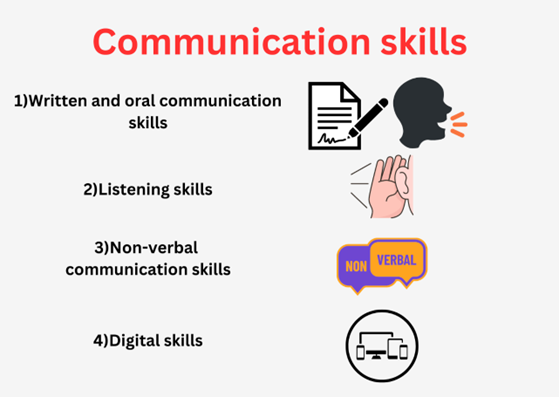
In conclusion, effective communication skills are essential for success in modern businesses. While technical knowledge is necessary, possessing soft skills, particularly communication skills, is equally important. Communication skills include written and oral communication, listening skills, nonverbal communication, and digital skills, all of which play a crucial role in business communication. The tourism and hospitality industry is particularly dependent on communication skills due to its focus on interactions between employees and tourists. As businesses continue to evolve in the digital age, digital literacy and digital communication skills have become increasingly crucial. Developing and honing communication skills can enhance business efficiency, employee job satisfaction, and positive interactions with stakeholders.
[1] There is a specific bitesize in this eLearning Tool called “Digitalization & tourism” that explains Digital Skills in detail.
[2] If you wish to explore further the importance of Communication Skills, you may go to Module 3 “Digital Social Skills”