Completion requirements
View
2. Collaboration Process
2.3. Collaboration Process
Regardless of the form the collaboration takes, the following stages can generally be observed:
- Identification of SMART goals and objectives. This answers the question: why collaborate with others, what benefits do you seek to gain from the collaboration process?
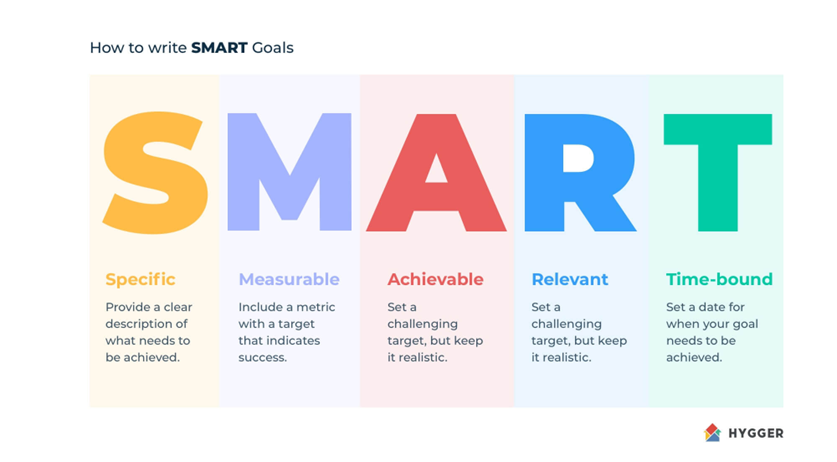 Source: How to Formulate and Apply SMART Goals and Objectives? |
Hygger.io
Source: How to Formulate and Apply SMART Goals and Objectives? |
Hygger.ioWe suggest that, as you begin to reflect on a future collaboration, you set 3 SMART objectives in advance that align with your business mission and vision.
- Mapping potential collaborators. Networking, as we shall see, is a key tool for any professional and is also particularly important when initiating a collaboration process with others, as it allows access to a variety of profiles that meet the needs and expectations of the collaboration.
- Define roles and responsibilities for the collaboration. Assigning clear roles and tasks among the participants will be key for the follow-up and management of the collaboration process, as well as for monitoring the results and establishing corrective measures if necessary. For an optimal outcome, it is necessary to make an effort to understand each other's needs and objectives, and to reach an agreement that is realistic and beneficial for all involved.
- Co-design a communication and collaboration management protocol. In the case of a long-term collaboration, or if the complexity of the project requires it, it will be necessary to design a protocol that all collaborators will follow when working together. In addition, establishing guidelines on how to communicate will help to reduce potential risks.
- Evaluation of results. Whether it is a one-off collaboration or a sustained professional relationship that generates added value for all partners, it will be necessary to monitor the results obtained through the collaboration. In this way, it is possible to detect areas for improvement or to understand whether the time and effort invested have been efficient.
All these stages of collaboration can take place both in the face-to-face and online environment, especially if we take into account that as a consequence of globalisation and the internet, it is more and more likely to establish collaborative processes with agents who are located at a distance.
For the online management of a collaborative process with others, you will need to use digital tools such as:
● Digital communication tools: email, social networks, video call solutions, etc.
● Task/project management tools (when required by the results to be achieved): there are many online task managers that can be easily incorporated into your daily activities, such as ClickUp, Trello, Asana, etc.